Establishing a robust, completely self-hosted smart home network has shifted from an experimental technology hobby into a core piece of residential digital infrastructure across Aotearoa New Zealand. With the near-universal rollout of Ultra-Fast Broadband (UFB) fibre pipelines and high-capacity wireless connections, the volume of internet-connected appliances, smart lighting grids, security cameras, and automated climate control systems inside the average Kiwi home has expanded exponentially.
However, relying exclusively on mainstream commercial smart home platforms introduces massive long-term operational vulnerabilities, including continuous subscription price hikes, invasive corporate telemetry tracking, and the persistent frustration of total network lockouts when global cloud data centres go offline. Deploying the specialized home assistant green nz hardware ecosystem permanently resolves these infrastructure bottlenecks, shifting your property away from vulnerable cloud-dependent architectures and embracing an independent local automation engine.
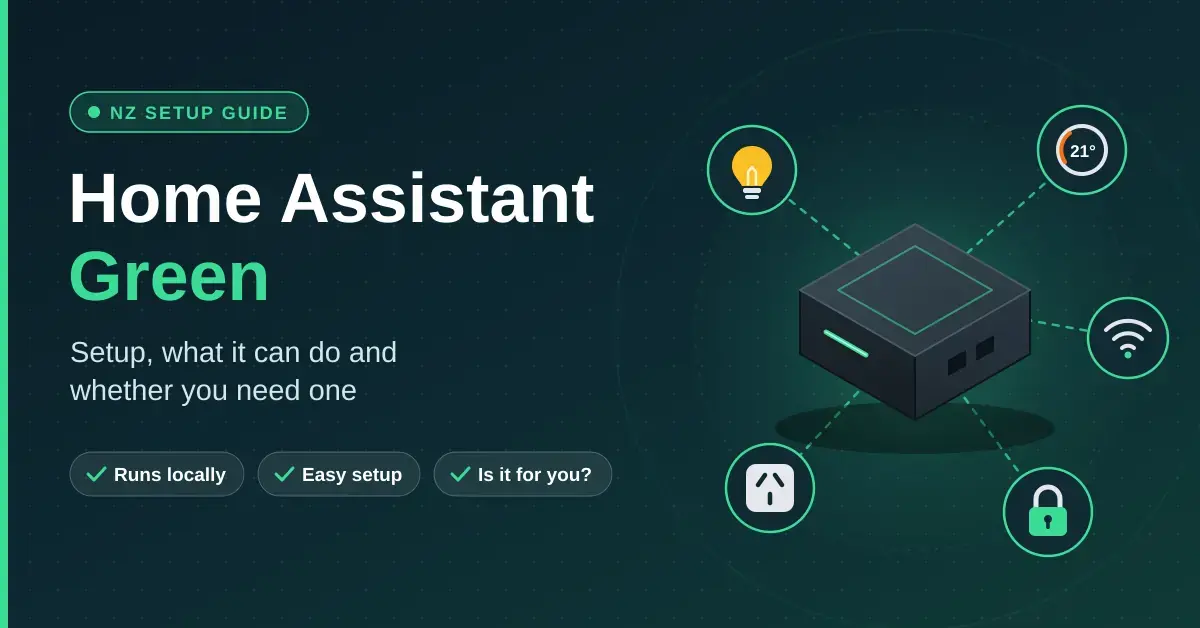
This purpose-built smart home hub acts as the centralized command deck for your entire property, combining software-defined connectivity with absolute privacy safekeeping to ensure your home runs flawlessly regardless of external web parameters. Whether you are aiming to coordinate complex lighting scenes in an Auckland townhouse, optimize solar energy consumption on a lifestyle block in Hamilton, or unify mismatched smart devices in a Christchurch family home, mastering this dedicated local controller is the absolute key to building a future-proof automated household.

- Absolute Data Independence: Processes and archives all automation logic, sensor readings, and security events locally within your physical walls, completely avoiding mandatory offshore cloud relays.
- Plug-and-Play Simplicity: Arrives pre-installed with the complete local software stack out of the box, eliminating the traditional setup friction associated with raw flashing procedures.
- Massive Device Interoperability: Bridges data communications flawlessly across thousands of disparate smart appliance brands, including Philips Hue, Tuya, Sonos, and local heat pump units.
- Zero Ongoing Subscription Surcharges: Operates on a transparent open-source model that completely unlocks all advanced scheduling, dashboard customization, and historical logging features for free.
- Ultra-Low Power Efficiency: Engineered as an eco-friendly computation node that draws a minor trickle of electricity from your wall outlet, keeping ongoing running costs exceptionally low.
The Core Philosophy of Home Assistant and Local Sovereign Automation
The rapidly changing dynamics of the residential automation market across New Zealand have driven a massive consolidation in how homeowners approach smart property development. In past hardware cycles, building an automated household required choosing a singular commercial ecosystem and purchasing products strictly within that brand’s approved list. This closed-loop framework created severe vendor lock-in, forcing consumers to manage multiple un-coordinated smartphone apps that refused to communicate laterally with one another. The emergence of the open-source home assistant software engine completely revolutionized this landscape, abstracting the control plane away from proprietary platforms to deliver a unified, brand-agnostic data translation fabric that operates completely within your local area network.
By establishing a localized processing core on your property, you reclaim absolute structural sovereignty over your private household data pipelines. Traditional corporate smart hubs are explicitly built around recurring revenue models and cloud tracking matrices, transmitting your intimate daily routines, occupancy schedules, and camera motion triggers back to international data centers for commercial profiling. This localized hub completely neutralizes this privacy erosion by executing all automation scripts, biometric profile checks, and data archives locally inside your home. If a localized storm front knocks your regional internet connection offline, your automated lighting loops, security triggers, and climate profiles continue to execute perfectly, fully insulated from external web outages.
| Smart Home Architecture Metric | Cloud-Dependent Proprietary Hubs | Home Assistant Local Sovereign Grids |
|---|---|---|
| Primary Data Processing Zone | Offshore global corporate cloud servers | Localized physical computing hardware in your home |
| Ongoing Monthly Software Fees | High risk of premium feature subscription locks | $0.00 (Absolute lifetime free open-source access) |
| Internet Outage Resilience | Total system failure; routines stop executing | 100% Operational autonomy across local networks |
| Device Brand Interoperability | Heavily restricted to approved closed ecosystems | Near-universal scaling across thousands of brands |
| Hardware Lifecycle Longevity | High risk of planned obsolescence via forced updates | Scalable modular hardware controlled by the user |
Why Cloud Dependency Fails the Modern Kiwi Household
Relying on internet-connected external servers to execute basic household commands introduces severe performance delays and systemic operational risks. When you press a wireless smart switch on your wall clad in a cloud-dependent setup, the electrical signal must first travel out across international submarine cables to validate the instruction at an offshore corporate data centre, before returning to trigger the light bulb sitting a mere two metres away from you. This circuitous data path introduces noticeable latency and creates a fragile single point of failure. Transitioning to a local controller ensures that commands translate between accessories within mere fractions of a millisecond, providing a snappy, instantaneous user experience that feels completely indistinguishable from traditional hardwired copper switches.
Unboxing the Home Assistant Green NZ Ecosystem
For many technology enthusiasts looking to secure their property’s digital legacy, deploying a specialized hardware controller like the home assistant green nz edition serves as the ultimate cornerstone for automated home development. For years, setting up a local smart environment required sourcing a raw Raspberry Pi circuit board, purchasing separate power brick adapters, and navigating complex terminal line instructions to flash the operating system onto a high-wear microSD card. The Green hardware kit permanently eliminates this initial setup friction by providing a complete, consumer-ready appliance enclosed in a clean, translucent polymer shell that houses a highly optimized solid-state computing engine.
The physical kit is explicitly engineered as a turnkey appliance, arriving out of the box with the complete operating system pre-flashed onto durable, industrial-grade onboard storage media. The retail box includes the centralized computing hub, a high-quality global AC power adapter with correct New Zealand plug pins, and a premium flat Ethernet networking cable to link the unit directly into your primary home router. The minimalist, fanless structural design relies entirely on passive thermal cooling dissipation vents wrapped around the upper casing, ensuring the hub operates in absolute silence 24 hours a day without generating annoying mechanical vibrations or attracting interior dust buildup inside your utility room.
Hardware Specifications and Processing Efficiency Built for Purpose
Underneath its compact translucent housing sits a balanced, energy-efficient microarchitectural platform designed specifically to coordinate continuous home automation workloads without inflating your monthly power statements. The hub is powered by a quad-core Rockchip processor running at a stable 1.8 GHz, coupled with 4GB of high-speed RAM and a massive 32GB of high-reliability eMMC solid-state storage media. This dedicated storage choice represents a massive engineering upgrade over basic microSD card implementations, which are notoriously prone to sudden file corruption and total system crashes under the continuous write cycles demanded by home automation databases.
- Quad-Core Processing Silicon: Delivers responsive multi-threaded execution paths to compute dozens of parallel automation scripts instantly.
- eMMC Solid-State Media: Provides superior read-write longevity compared to consumer-grade memory cards, protecting your system configuration from corruption.
- Dual USB Expansion Allocation: Incorporates two dedicated external USB 2.0 ports to accept high-power long-range radio dongles for Zigbee, Z-Wave, and Thread protocols.
- Gigabit Ethernet Connection: Guarantees an ultra-stable, high-bandwidth physical network path to route data streams fluidly across your local switches.
- MicroSD Safety Recovery Slot: Features an external memory slot reserved exclusively for executing manual system diagnostics or restoring bare-metal master recovery images.
Comparing Home Assistant Green NZ with Raspberry Pi and Custom Rigs
When planning a comprehensive deployment of home assistant nz systems, executing an intensive architectural comparison between purpose-built appliances and custom hardware builds is an essential checkpoint for your asset budget. Sourcing a generic Raspberry Pi development board remains an exceptionally popular pathway for advanced computer hobbyists who enjoy configuring raw operating system files and tweaking low-level kernel parameters manually. A custom single-board computer allows you to choose your own external enclosure designs, add aftermarket active cooling fans, and adjust physical component metrics to suit specific testing conditions.
However, when evaluated through the lens of long-term household reliability, energy consumption profiles, and absolute ease of deployment, custom-built development rigs introduce significant operational hidden costs. Sourcing an un-vetted Raspberry Pi board, a high-quality case, an explicit power adapter, and an industrial-grade storage drive quickly aggregates into a transaction total that matches or exceeds the cost of a pre-configured Green hub. Furthermore, development boards lack built-in voltage conditioning safety lines, leaving the system highly vulnerable to data corruption if a brief voltage sag or power cut occurs on your local electrical grid.
| Hardware Deployment Attribute | Home Assistant Green Built-for-Purpose Hub | Standard Raspberry Pi Development Kit | Independent Custom Server Rig |
|---|---|---|---|
| Out-of-the-Box Readiness | 100% Plug-and-play; pre-flashed operating system | Requires manual flashing and software configuration | Demands advanced systems virtualization knowledge |
| Core Storage Reliability | High-durability onboard eMMC solid-state media | Highly vulnerable to consumer microSD card wear | Relies on spinning hard disks or expensive SSD arrays |
| Continuous Power Consumption | Ultra-low draw; typically hovers between 1.5W and 3.5W | Moderate draw; requires high-quality dedicated supplies | High continuous draw; typically climbs between 25W and 60W |
| Physical Space Footprint | Ultra-compact, fanless translucent desktop enclosure | Exposed circuit board layout unless third-party case bought | Substantial physical presence within utility racks |
| System Durability Protections | Integrated electrical line smoothing circuits | Prone to hardware resets during sudden voltage drops | Dependent on external line conditioners or smart UPS blocks |
The Seamless Out-of-the-Box Setup Advantage for Everyday Users
Opting for the purpose-built Green hub completely redefines the onboarding experience for everyday families who want to automate their sections without becoming network engineers. Instead of wasting an entire weekend downloading flashing tools, diagnosing storage write errors, and hunting for compatible power bricks across retail sites, you simply plug the flat network cable into your Spark or Vodafone router, connect the power brick to the wall socket, and watch the system initialize automatically. Within less than five minutes, the hub compiles its initial network state and broadcasts a secure local address, letting you configure your master administrator dashboard directly from any web browser or mobile device on your network.
Native Protocol Integration: Zigbee, Thread, and Matter in Aotearoa
The ultimate long-term success of an automated property depends heavily on the physical wireless protocols used by individual smart sensors to communicate across your section. While basic consumer smart light bulbs and cheap power plugs rely almost exclusively on standard home Wi-Fi networks to pass data, crowding your primary router with dozens of individual smart home accessories is an architectural recipe for network congestion. Standard home Wi-Fi routers are optimized to deliver high-bandwidth data bursts to a small volume of devices like laptops and streaming TVs; forcing them to continuously track dozens of low-power smart switches results in severe data packet collisions, reduced range, and random device dropouts.
To bypass this wireless bottleneck, high-performance smart installations utilize dedicated mesh radio networks operating completely independent of your home internet traffic. By dropping a specialized USB radio adapter—such as the official SkyConnect dongle—into one of the expansion ports of your Green hub, you instantly unlock native support for advanced automation protocols including Zigbee, Thread, and the newly unified global Matter standard. These specialized radio networks operate on an ultra-low-power micro-amp profile, allowing compact wireless motion sensors, door contact switches, and smart thermostats to run comfortably on a single lithium button battery for multiple years continuously.
- Self-Healing Mesh Topology: Every mains-powered device (such as a smart wall switch or power outlet) acts as a dynamic signal repeater, automatically passing data packets along to adjacent nodes to stretch wireless coverage effortlessly across sprawling multi-story properties.
- Low-Latency Thread Routing: Utilizes advanced IP-based mesh networking to deliver near-instantaneous command translation paths, ensuring smart sensors respond within milliseconds of physical interaction.
- Unified Matter Interoperability: Bridges structural communication gaps across competitive international tech ecosystems, allowing Apple-certified and Google-certified smart accessories to run side-by-side on a single local hub.
- Spectrum Congestion Relief: Shifts your low-bandwidth home automation sensors onto distinct, highly efficient channel matrices to preserve your main router’s wireless fields for data-heavy tasks like 4K streaming.
- Hardware Isolation Security: Keeps your smart home accessories completely disconnected from the open internet, preventing external hackers from exploiting vulnerable bulb firmware to breach your private home laptops.
Future-Proofing Your Smart Infrastructure Against Shifting Standards
The smart home industry has historically been plagued by rapid shifts in wireless connectivity trends, frequently leaving early adopters stranded with obsolete, unsupported hardware assets when a major tech giant decides to discontinue a proprietary cloud system. The open-source architecture embedded within this local controller handles this risk by treating wireless protocols as abstract, modular modules. If a new global wireless standard emerges in the coming years, you do not need to throw away your expensive Green hub; you simply plug a matching updated USB radio adapter into the expansion bay, download the community-developed software integration patch, and continue scaling your smart section seamlessly.
Step-by-Step Deployment and Configuration Guide for New Zealand Homes
Transitioning your property from a fragmented collection of mismatched smart apps to a fully unified, local sovereign automation network is a straightforward process that can be achieved cleanly in a single afternoon. Because the hardware arrives pre-flashed with the complete operating system architecture out of the box, your setup focus centers entirely on physical positioning, initial network discovery, and configuring your secure localized user access controls.
Before letting the machine execute its initial network scouting sweep to discover the smart devices across your section, it is a critical best practice to ensure your primary home router is configured with a permanent static IP reservation for the hub. If you allow your router to assign random IP addresses via standard dynamic configuration protocols, the hub’s local network address may shift unexpectedly every time your home experiences a temporary power cut, causing connected smartphones and tablet control panels to lose track of the command deck.
The Onboarding Sequence
Position the translucent hub on a completely flat, stable shelf adjacent to your primary internet router, ensuring at least 10 centimetres of open air clearance around the cooling vents to facilitate passive thermal dissipation.
Plug the included flat Ethernet cable into a high-speed LAN port on your router, connect the proprietary DC power adapter to a standard 230V wall outlet, and wait for the front status LED to glow solid green.
Open a web browser on any computer linked to the local network, navigate straight to the secure homeassistant.local address, and allow the internal solid-state media to compile its master database blocks.
Establish a unique, strong master administrator username, configure a highly secure password, and use the interactive map pin tool to set your precise geographic coordinates for localized weather automation.
Smart Home Ecosystem Integration: Apple HomeKit, Google Home, and Alexa
One of the most profound operational advantages unlocked when deploying a central home assistant green nz controller is the absolute freedom to bridge disparate, competitive smart home ecosystems into a single, cohesive automation fabric. In the standard retail consumer marketplace, smart home hardware is deliberately segregated by commercial brands attempting to force users into a singular product loop. If half of your family members utilize Apple iPhones while the other half favor Google Android devices, you are frequently trapped in an irritating operational deadlock where certain family members cannot control the lounge lighting or adjust the hallway climate because the underlying accessories refuse to interface natively across competitive operating systems.
The advanced software-defined translation architecture embedded within this hub eliminates these commercial boundaries entirely by functioning as a universal digital translator bridge. The hub listens for incoming state changes from any connected device on your section, translates the data packets into a standardized open-source code base, and projects the unified control field out to any smart display or smartphone interface simultaneously. This means you can confidently purchase a high-quality Zigbee motion sensor, pair it directly with your Green controller, and use it to simultaneously trigger an Apple HomeKit-certified light bulb, log an event in a Google Home dashboard, and announce an alert via an Amazon Echo smart speaker in the kitchen.
Bridging Disparate Smart Brands into a Single Local Unified Dashboard
The internal HomeKit Device and Google Home integration modules allow you to export any local device connected to your hub straight into your preferred mainstream smartphone ecosystem. This means you can continue utilizing familiar visual control interfaces like the native Apple Home app on your iPhone or voice commands via Google Assistant on your smart displays, while letting the Green hub handle the actual heavy lifting of local automation routing, data logging, and protocol management silently in the background.
- Native Apple HomeKit Emulation: Exports non-certified, affordable smart sensors directly into the iOS Home app, unlocking secure remote Siri voice control without purchasing expensive Apple-licensed gear.
- Synchronised Google Home Integration: Syncs local lighting matrices and multi-room audio zones straight to Google Assistant displays for seamless touch control.
- Unified Amazon Alexa Routine Triggers: Maps local physical motion events to trigger complex Alexa voice announcements and routine actions across Echo speakers.
- Granular Lovelace Dashboard Design: Provides an exceptionally customisable, drag-and-drop web interface to build bespoke touch control panels optimized for wall-mounted tablets.
- Isolated Guest Access Controls: Allows you to build restricted, cut-down user profiles for visitors or short-term holiday tenants, hiding sensitive core automation codes completely.
Managing Smart Lighting, Switches, and Power Outlets for Energy Efficiency
With commercial electricity rates a consistent consideration for New Zealand households, leveraging home automation to actively minimize your energy footprint and lower your monthly utility statements is a smart operational strategy. Lighting networks across traditional freestanding Kiwi homes are notoriously inefficient, frequently left burning at full brightness inside unoccupied hallways, empty spare bedrooms, or external carports for hours at a time due to human forgetfulness. Replacing old manual wall switches with smart, software-defined automation modules allows your central controller to monitor occupancy states continuously, matching light levels precisely to your family’s actual spatial movements.
By pairing your centralized hub with long-range Zigbee motion sensors and ambient light meters, you can build highly intelligent, multi-layered lighting profiles that adapt dynamically throughout the day. For instance, you can instruct the system to activate your kitchen downlights at 100% cool white brightness during busy morning breakfast preparation hours—but if a family member steps out of bed to fetch a glass of water at 2:00 AM, the hub senses the movement and illuminates the hallway path at a gentle, non-glaring 5% warm dim intensity, preventing sleep disruption while minimizing power draw from the national grid.
Optimising Energy Consumption Profiles to Lower Household Power Bills
The Phantom Standby Power Squeeze: Thousands of Kiwi homes waste hundreds of dollars every single year on “phantom power”—the continuous, silent electrical trickle drawn by home entertainment systems, gaming consoles, desktop computing arrays, and kitchen appliances while they sit completely idle in standby mode. By plugging these high-draw appliance clusters into smart power outlets linked directly to your Green controller, you can establish automated power-cut routines that completely isolate the circuits from the mains grid the absolute second your security system arms into “Away” mode or logs that the household is asleep.
Localized Climate Control and Heat Pump Integration Strategies
Managing the thermal efficiency and indoor air quality of a residential property across Aotearoa New Zealand presents a unique set of meteorological challenges. From the humid, sub-tropical dampness common throughout winter in Auckland to the sub-zero alpine frosts that blanket Central Otago and the Canterbury Plains, maintaining a healthy, bone-dry indoor environment requires consistent, intelligent climate control management. Heat pumps have become the near-universal standard for domestic heating and cooling across Kiwi sections, but standard factory infrared remote controllers are highly primitive, forcing users to manually guess temperature settings and leave units running inefficiently for hours.
Integrating your heat pump system directly into your localized automation core transforms a basic climate appliance into an intelligent, self-regulating environmental shield. By utilizing specialized open-source integration tools—such as the community-developed Sensibo or Mitsubishi Mitsubishi Cloud integrations—the hub bypasses standard remote controllers entirely, adjusting fan speeds, vane angles, and target temperature thresholds dynamically based on real-time data collected from independent wireless temperature and humidity sensors placed across your living spaces.
Climate Performance Comparison Metrics
| Climate Control Strategy | Standard Manual Remote Operations | Automated Software-Defined Climate Control |
|---|---|---|
| Temperature Sensor Placement | Restricted strictly to the internal return air intake at the high ceiling unit | Distributed across multiple low-level wireless sensors positioned exactly where family members sit |
| Humidity Mitigation Control | Completely absent; requires manual toggling of complex dry modes | Automatic activation of specialized dehumidification cycles when indoor moisture metrics climb past 60% |
| Geofenced Presence Tracking | Relies entirely on human memory to turn the appliance off when leaving | Automatically cuts power to the heat pump the absolute second the master smartphone crosses your section fence line |
| Solar Heat Gain Balancing | Static settings; fails to adapt to changing outdoor weather patterns | Dynamically drops heating targets when ambient light sensors detect free thermal warmth streaming through north-facing glass |
Customizing Automation Routines for New Zealand Weather Extremes
By leveraging the advanced automation engine inside your local controller, you can design highly resilient climate defense scripts tailored explicitly to combat regional mold and condensation risks. For example, you can program an automated routine that monitors both indoor relative humidity metrics and outdoor weather data simultaneously. If the internal humidity inside your bedrooms climbs past a critical 65% threshold while the outdoor air remains dry, the hub can automatically crack open automated window ventilation latches, initialize a balanced mechanical heat recovery ventilation cycle, or ramp your heat pump into a highly efficient “Dry Mode” sweep to strip moisture out of the building fabric before destructive mold spores can take root.
Advanced Security, Camera Monitoring, and Local Privacy Safekeeping
Securing the exterior boundaries of your section and safeguarding your family’s personal privacy requires moving away from traditional closed-circuit television systems and embracing intelligent, software-defined surveillance networks. Legacy camera systems are notoriously restrictive, either forcing you to budget for expensive commercial electricians to route heavy coaxial video cables back to a centralized recording box, or locking your security footage behind mandatory cloud subscriptions that upload your private video data to offshore global servers. This cloud approach leaves your personal privacy completely vulnerable to data leaks and external corporate exploitation.
The advanced camera integration modules embedded within the platform completely dismantle this restrictive paywall by allowing you to stream high-definition video feeds from any standard IP surveillance camera directly into your secure local dashboard via open-source protocols like RTSP (Real-Time Streaming Protocol). By coupling your camera network with powerful community-developed artificial intelligence add-ons—such as the highly respected Frigate NVR ecosystem—your centralized Green hub transforms into an elite, evidence-grade surveillance brain that processes raw video data streams locally on-device. Wikipedia
Implementing Biometric Form Tracking and Fee-Free Video Archives
- Local Object Classification: Uses advanced computer vision algorithms to accurately separate the volumetric shapes of humans, vehicles, and animals in real-time, completely eliminating annoying false alerts driven by swaying trees or moving shadows.
- Virtual Security Fence Lines: Allows you to draw precise digital boundary tripwires across your driveway or garden gates, triggering immediate high-output spotlights and audible warning chimes the absolute millisecond an uninvited visitor steps onto your property.
- Encrypted Local NVR Archiving: Saves motion-activated event clips and non-stop surveillance video records straight to expandable storage pools positioned safely inside your lounge, ensuring footage remains accessible during broadband cuts.
- Instant Priority Push Alerts: Transmits rich, image-packed push notifications straight to your smartphone screen the instant an anomaly is verified, allowing you to view real-time live video streams from anywhere globally via secure network tunnels.
- Seamless Intercom Talkback Integration: Links physical video doorbells directly to your home automation panels, enabling you to converse clearly with couriers or warn off trespassers through noise-cancelling microphone arrays.
Consumer Protections and Sourcing Long-Term Hardware Value in NZ
Because overhauling your property’s digital architecture with a high-performance home server or network-attached storage array involves a substantial upfront financial commitment, understanding your statutory legal safeguards as a consumer is highly important. Any computer components, enterprise storage drives, turnkey server towers, or network switches purchased through a legitimate New Zealand retail storefront or an authorized local online e-commerce platform are automatically protected by the strict legal frameworks of the Consumer Guarantees Act (CGA) and the Fair Trading Act.
Under the CGA, any physical electronic item sold for domestic or residential utilization must prove of acceptable manufacturing quality, function completely as explicitly advertised by the distributor, and remain durable enough to survive for a reasonable operational timeframe relative to its retail price point. If your newly provisioned local system encounters an unexpected motherboard component failure, a terminal power supply board breakdown, or a complete collapse of its wireless transmitter within a year or two of normal, climate-controlled residential operation, local commercial suppliers are legally obligated to provide a proper remedy.
Sourcing Local Technical Hardware and Warranty Channels
To ensure you have seamless access to robust local consumer safeguards, professional technical support channels, and correct New Zealand electrical plug configurations, it is highly recommended to purchase your server hardware through established local supply chains. Sourcing an obscure parallel-imported storage system from an un-vetted global website might save you a few dollars on the initial transaction, but it can leave you completely exposed if a component fails prematurely. Local technical distributors maintain dedicated returns networks, ensuring that if a structural fault occurs, you can secure a free expert repair, a brand-new replacement component, or a complete financial refund quickly.
- The Durability Mandate: The CGA overrides arbitrary 12-month manufacturer warranties, requiring computing appliances to last for a reasonable timeframe relative to its cost.
- Accidental Damage Exclusion: Consumer protection laws strictly do not cover equipment that fails due to drop damage, physical installation blunders, or un-mitigated liquids leaks.
- Local Dispute Resolution: Gives Kiwi buyers access to the standard Disputes Tribunal if a local technical distributor refuses to honor a valid structural repair claim.
Summary
Migrating your family’s digital footprint onto an autonomous open-source home server or network-attached storage array represents a massive leap forward in agility, cost efficiency, and absolute data privacy sovereignty for technology users across Aotearoa New Zealand. By combining high-performance bare-metal hypervisors with advanced, self-healing software-defined file systems like OpenZFS, a localized network node delivers an enterprise-ready data ecosystem that completely removes the financial burden and security risks of public cloud platform subscriptions. Whether your primary objective is to build an elegant, high-definition home cinema streaming hub using hardware-assisted video transcoding, orchestrate a bulletproof multi-tiered automated backup network to guard against malicious ransomware scripts, or host isolated container grids for advanced smart home automation networks, this technology puts absolute sovereignty back in your hands. By matching your specific processing requirements with the appropriate network storage hard drive families, protecting delicate internal hardware with line-interactive power conditioners, and purchasing components through authorized local retail channels backed fully by the Consumer Guarantees Act, you can enjoy a fully scalable, secure, and cost-effective digital foundation that insulates your household’s data assets for years to come.
FAQ
What is the primary difference between Home Assistant Green and a custom Raspberry Pi setup?
Home Assistant Green arrives as a fully assembled, turnkey consumer appliance pre-installed with the complete operating system pre-flashed onto high-durability onboard eMMC solid-state media out of the box, whereas a custom Raspberry Pi kit requires manual component assembly, separate power brick sourcing, and complex software flashing procedures onto high-wear consumer microSD cards.
Will the local smart hub continue to execute automations if my internet drops offline?
Yes, because the core architecture is engineered as a local sovereign automation engine that executes all processing logic, script evaluations, and device communications locally inside your home network, your automated lighting scenes, security boundaries, and climate control profiles continue to run perfectly during a complete external internet provider outage.
Do I need to pay any ongoing monthly subscription fees to use this smart home hub?
No, the core development philosophy of the platform operates entirely on an open-source model that completely unlocks all advanced scheduling parameters, interactive history charts, historical data logging arrays, and localized dashboard design modules entirely for free out of the box, with absolute zero mandatory recurring software licensing fees.
How many separate smart device brands can connect to a single Green controller simultaneously?
The highly versatile software translation fabric features native community-developed integration hooks for greater than 2,500 independent international smart appliance families, allowing you to seamlessly bridge competitive accessories from brands like Philips Hue, Sonos, Tuya, Xiaomi, and local heat pumps into a single unified control panel.
Can I control my local home automation dashboard securely when traveling away from home?
Yes, while your data remains encrypted locally inside your house, you can establish secure, encrypted virtual private network (VPN) tunnels or deploy a premium cloud relay integration via Nabu Casa for roughly $10 per month, allowing you to monitor sensor logs and control switches from anywhere globally while funding open-source development.
What wireless protocol dongle is best recommended to expand this hub’s radio range?
To unlock native mesh radio networking capabilities for specialized low-power smart sensors, it is highly recommended to plug the official Home Assistant SkyConnect USB adapter into an expansion slot, instantly provisioning secure local channels for Zigbee, Thread, and next-generation Matter accessories.
Is it safe to leave the translucent computing hub permanently powered on all day and night?
Yes, the specialized hardware is explicitly engineered and component-hardened for continuous, round-the-clock bare-metal operation 24 hours a day throughout the year. The passive cooling architecture dissipates thermal warmth silently without needing mechanical fans, drawing an exceptionally low 1.5 to 3.5 watts of power from your electrical outlet.
Can the smart hub save multi-level floor blueprints for a large two-story townhouse?
Yes, the modern application database can store and organize multiple separate digital maps and structural configurations under a single user profile dashboard, letting you organize control icons by distinct building levels, separate outbuildings, or detached garden sleepout zones for intuitive touch control.
How does localized AI form detection eliminate annoying smartphone notification fatigue?
Instead of reacting blindly to generic pixel shifts inside a video frame—like a tree branch swaying in the wind or a passing cloud shadow—advanced on-device AI algorithms analyze the volumetric shape and movement vector of objects in real-time, filtering out harmless ambient movement before buzzing your phone.
Are my smart home equipment and controller hardware purchases protected under New Zealand law?
Yes, any specialized smart home hubs, radio adapters, wireless sensors, or automated switches purchased through an authorized retail storefront or an official online distributor within New Zealand are fully covered under the protective legal frameworks of the Consumer Guarantees Act (CGA), ensuring your gear must perform reliably as advertised.