

The best Tapo camera for most NZ homes is the Tapo C210, a 2K pan/tilt indoor camera from about $59, paired with a C520WS or C320WS on any outside wall that has power nearby. Where there is no power, the battery-powered C425 is the one to buy. Every Tapo security camera records to a microSD card for free, so a subscription is optional.
This guide is for NZ households, renters and small businesses picking a Tapo camera from TP-Link’s dozens of model numbers: which ones are worth the money, what is free and when Tapo Care makes sense. For the bigger decisions, such as wired or wireless and cloud or local recording, start with our home security camera guide.
Key takeaways
- Indoor pan/tilt Tapo cameras (C200, C210, C220) are among the cheapest capable security cameras in NZ, from about $45 to $72.
- Outdoors, choose by power first: plug-in (C320WS, C520WS), battery (C425) or a solar kit (C610 KIT, C660 KIT).
- Live view, alerts, person, pet and vehicle detection and microSD recording are free. Tapo Care adds 30 days of cloud clips and snapshot alerts.
- Most Tapo cameras connect on 2.4 GHz Wi-Fi only. The C260 and C660 KIT also work on 5 GHz.
- Plug-in models support RTSP and ONVIF for NVRs and Home Assistant. Battery and solar models don’t.
In this guide
- Which Tapo camera should you buy?
- Tapo camera range and NZ prices at a glance
- Tapo C200 vs C210 vs C220: the indoor cameras
- Tapo outdoor cameras: plug-in, battery or solar
- The Tapo app, SD cards and Tapo Care
- Setting up a Tapo security camera
- Tapo cameras and privacy law in NZ
- Common mistakes to avoid
- Tapo vs eufy and Arlo
Which Tapo camera should you buy?
Start with power, not resolution. A plug-in camera is cheaper, can record around the clock and never needs charging, so battery and solar models only make sense where a cable is impractical. Then decide whether it should sweep a room or yard (pan/tilt) or watch one spot (fixed). The picker turns those choices into a model and a current NZ price.
Tapo camera picker
Choose where the camera goes, how it gets power, whether it should pan and how much detail you want. It suggests the Tapo model to shortlist, with the lowest NZ price we found in September 2026.
Prices are the lowest NZ retail listings we found in September 2026 (NZ$ incl. GST) and change often. Every model records to a microSD card, sold separately; Tapo Care cloud storage is optional.
If you would rather skim, this is the shortlist we would give a friend:
- Inside, best value: Tapo C210 (2K 3MP pan/tilt), from about $59.
- Outside wall near a power point: Tapo C320WS (fixed) from about $111, or the C520WS (pan/tilt) from about $113.
- Outside with no power: Tapo C425 battery camera, from about $172.
- A gate, shed or long driveway: a solar kit such as the C610 KIT (from about $229) or the 4K C660 KIT (from about $240), provided your Wi-Fi reaches.
Tapo camera range and NZ prices at a glance
Tapo model numbers mostly follow a pattern: C1xx are fixed indoor cameras, C2xx indoor pan/tilt, C3xx fixed outdoor, C4xx battery, C5xx outdoor pan/tilt and C6xx solar kits. D-series models are video doorbells. The table covers the models most widely listed by NZ retailers such as PB Tech when we checked in September 2026.
| Model | Type | Resolution | Power | Wi-Fi | NZ price from |
|---|---|---|---|---|---|
| Tapo C200 | Indoor pan/tilt | 1080p | Plug-in | 2.4 GHz | $45 |
| Tapo C210 | Indoor pan/tilt | 2K 3MP | Plug-in | 2.4 GHz | $59 |
| Tapo C220 | Indoor pan/tilt | 2K 4MP | Plug-in | 2.4 GHz | $72 |
| Tapo C260 | Indoor pan/tilt | 4K 8MP | Plug-in | 2.4 and 5 GHz | $127 |
| Tapo C320WS | Outdoor fixed | 2K 4MP | Plug-in, Ethernet port | 2.4 GHz | $111 |
| Tapo C520WS | Outdoor pan/tilt | 2K 4MP | Plug-in, Ethernet port | 2.4 GHz | $113 |
| Tapo C425 | Outdoor battery | 2K 4MP | 10,000 mAh battery | 2.4 GHz | $172 |
| Tapo C660 KIT | Outdoor solar pan/tilt | 4K 8MP | Battery and solar panel | 2.4 and 5 GHz | $240 |
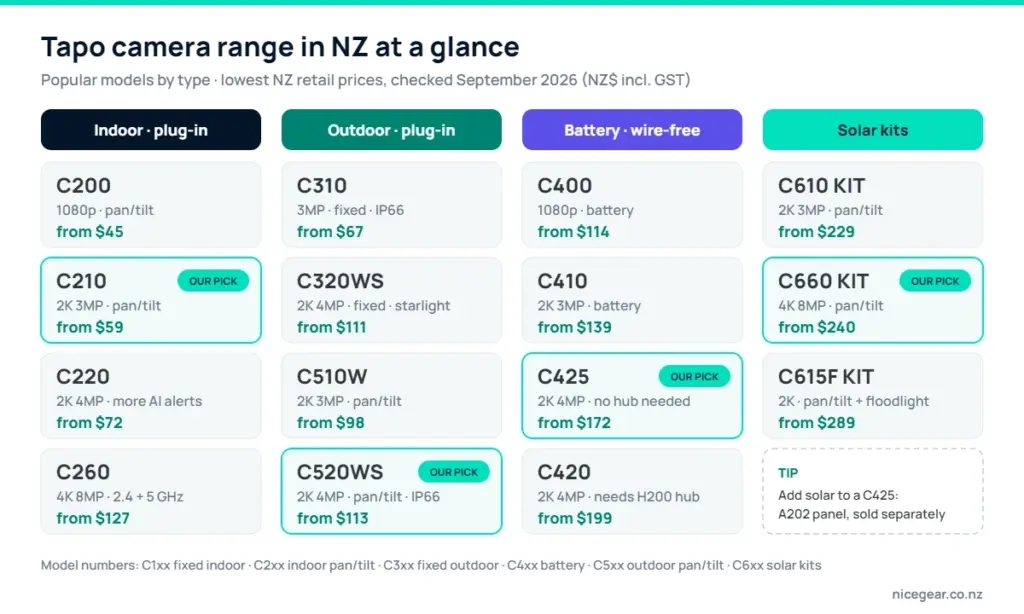
“From” prices are the lowest listings we found; other stores often charge more, and sales move prices weekly.
Tapo C200 vs C210 vs C220: the indoor cameras
These three look almost identical and share most features: 360-degree pan, infrared night vision to about 9 metres, two-way audio, privacy zones and microSD recording (up to 512 GB on the C210 and C220). The differences are the image sensor and the range of smart alerts.
Tapo C200 vs C210
The C210 records at 2304 x 1296 pixels (3MP) against the C200’s 1920 x 1080. That is about 44% more pixels, which shows when you zoom into a recording to read a face or the label on a parcel. The price gap is usually around $14, so the C210 is the better buy unless you only want to keep an eye on the cat.
When the C220 or C260 is worth the extra
The C220 steps up to 2560 x 1440 (2K 4MP) and adds more specific alerts: pet, vehicle, glass breaking, dog barking, cat meowing, line crossing and tamper detection, on top of person and baby-cry detection. That helps if you want an alert when the dog barks rather than every time it moves.
The C260 is Tapo’s 4K indoor option (3840 x 2160). It adds 5 GHz Wi-Fi, face recognition and a motorised shutter that physically blocks the lens in privacy mode. From about $127, it earns its price mainly in large open-plan rooms where you rely on digital zoom.
Tapo outdoor cameras: plug-in, battery or solar
Outdoors, power decides the model. Our outdoor security camera guide covers weatherproofing and placement in more depth; the Tapo-specific points are below.
Plug-in: Tapo C320WS and C520WS
Both record 2K 4MP (2560 x 1440), are rated IP66 and use a starlight sensor that keeps colour in low light, with infrared reaching about 30 metres. The C320WS has a fixed view. The C520WS pans 360 degrees and tilts through 130 degrees, so one camera can follow someone down a driveway. Both have an Ethernet port, and it is worth using: brick veneer, concrete block and foil-backed insulation all weaken Wi-Fi at an outside wall.
The power adapter is not weatherproof. Keep it indoors or in a weatherproof enclosure, and run the thin DC cable through the soffit or wall. If you need a new outdoor power point, that is a job for a registered electrician.
Tapo C425: the battery camera to buy
The C425 is a standalone 2K 4MP camera with a 10,000 mAh battery, colour night vision and an IP66 rating. It connects straight to your Wi-Fi, records to its own microSD card (up to 512 GB) and detects people, pets and vehicles. TP-Link quotes up to 300 days per charge, but that assumes only 230 seconds of activity a day. A busy front door or a driveway facing the street will need charging far more often.
Don’t confuse it with its siblings. The C420 is sold as part of a system with the Tapo H200 hub, so choose it only if you already have a hub or want several battery cameras on one. The cheaper C400 (1080p) and C410 (2K 3MP) work fine, but the C425’s sharper 4MP image is worth the difference at a front door.
Tapo solar cameras
Tapo’s solar kits pair a battery pan/tilt camera with a small panel: the C610 KIT (2K 3MP, from about $229), the C615F KIT (2K with a floodlight, from about $289) and the 4K C660 KIT (from about $240), which also has dual-band Wi-Fi and an IP65 rating. You can also add Tapo’s A202 panel to a C425.
A solar camera still needs Wi-Fi at the mounting spot, and the panel needs direct sun. The C660 KIT’s panel charges at up to 2.5 W, which is plenty in a Hawke’s Bay summer but marginal under a shaded eave in a Dunedin June. Our solar security camera guide includes a winter sunshine calculator for NZ cities.
The Tapo app, SD cards and Tapo Care
What the Tapo app does for free
The free Tapo app gives you live view, instant notifications, two-way audio, activity zones, privacy zones, motion and AI detection, and local recording to the microSD card, with no limit on the number of cameras. It also works with Alexa and Google Assistant, and the same app runs Tapo plugs and bulbs. If you already use Tapo smart plugs, your cameras simply appear alongside them.
Choosing a Tapo camera SD card
Tapo cameras don’t come with a card. TP-Link supports microSD cards from 8 GB to 512 GB rated Class 10, U1 and V10 or better, and strongly recommends high-endurance cards built for constant rewriting, such as SanDisk High Endurance, Samsung PRO Endurance or Kingston Endurance. It lists the 256 GB Samsung EVO Plus as incompatible.
TP-Link estimates that a 1080p camera recording continuously at 15 frames per second fills about 16 GB every 48 hours, or roughly 8 GB a day. Higher-resolution models use more, and motion-only recording uses far less.
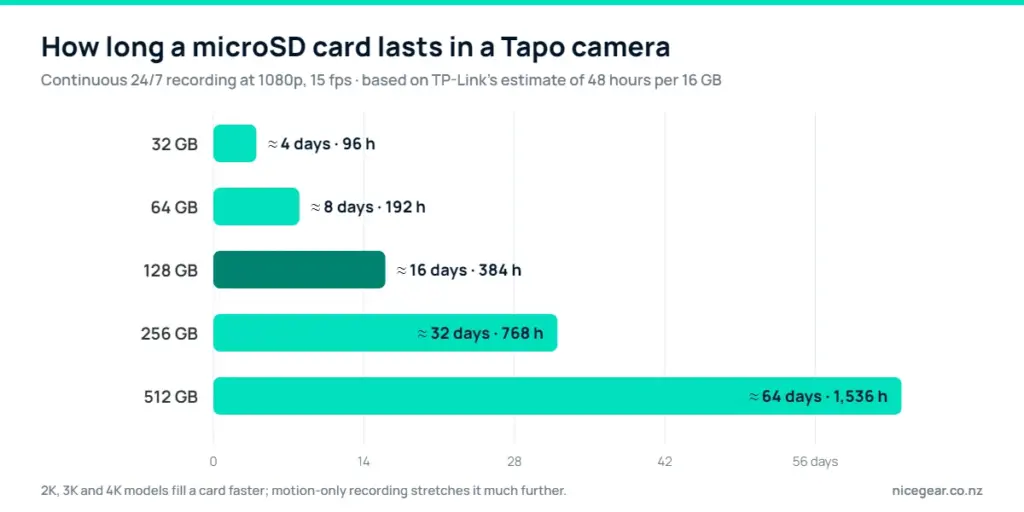
For most homes a 128 GB high-endurance card is the sweet spot: about two weeks of continuous 1080p, or several weeks of motion clips. When the card is full the camera records over the oldest footage, so save any clip you need before it disappears. To estimate storage for several cameras at different resolutions, use the storage calculator in our security camera buying guide.
Is Tapo Care worth it?
A Tapo Care subscription stores motion clips in the cloud for 30 days, adds snapshots to notifications and sorts clips by type. In Australia TP-Link lists it at A$4.99 a month or A$48.99 a year for one camera, with multi-camera plans covering up to 10 cameras and a one-off 30-day free trial. NZ pricing appears in the app when you subscribe; expect a similar figure in NZ dollars, roughly $5 to $6 a month per camera at current exchange rates.
It is worth paying for on outdoor cameras a burglar could reach, because a stolen camera takes its card with it. Elsewhere, free local recording is enough for most people.
Using Tapo with Home Assistant, Frigate or an NVR
Plug-in Tapo cameras support RTSP and ONVIF. Create a camera account in the app (Device Settings, then Advanced Settings, then Camera Account) and the camera can stream to an NVR, a NAS, Frigate or a Home Assistant Green box with no cloud involved. Battery and solar models such as the C425 and C660 KIT don’t support RTSP. Each camera also has a limited number of streams: with Tapo Care, an NVR and microSD recording all running, Tapo switches NVR recording off.
Setting up a Tapo security camera
Most setup problems come down to Wi-Fi and placement:
- Pair it next to the router, then move it. Setup is the step most likely to fail at the edge of Wi-Fi range.
- Check your Wi-Fi band. Most Tapo cameras use 2.4 GHz only. Routers and mesh systems that combine both bands under one network name usually work; if pairing fails, split them temporarily. Our mesh Wi-Fi guide covers getting signal to the far corners.
- Test the live view from the mounting spot on your phone before drilling.
- Mount outdoor cameras about 2.5 to 3 metres up, angled down and away from the rising or setting sun.
- Keep night-vision cameras away from windows. Infrared reflects off glass, so a camera looking through a window at night mostly records its own glare.
- Near the coast, use stainless screws and a drip loop. IP66 keeps rain out, but salt air still corrodes brackets and connectors.
Tapo cameras and privacy law in NZ
Home camera owners are mostly outside the Privacy Act, but the Office of the Privacy Commissioner says that changes if the filming would be highly offensive to a reasonable person, such as looking into a neighbour’s bathroom or watching their children play in the back yard. Its guidance on CCTV at home recommends talking to neighbours before installing, putting up a sign, not pointing cameras at their property or windows, keeping footage only as long as needed and never posting their footage on social media.
The Tapo app helps: privacy zones black out a neighbour’s window or the footpath, privacy mode turns a camera off at a tap, and two-step verification on your TP-Link ID protects the account if a password leaks. Keep camera firmware updated.
Common mistakes to avoid
- Buying battery where there is power. Battery cameras cost more, usually record short clips only and need recharging.
- Using a cheap microSD card. Constant rewriting wears out ordinary cards, and corrupted recordings are the usual symptom.
- Mounting within reach. Mount high, or back footage up to Tapo Care or an NVR.
- Treating cameras as an alarm. A camera records; it doesn’t call anyone. Our smart home security systems guide covers sensors and monitored alarms.
- Buying grey imports. Overseas marketplace listings can arrive with foreign plugs and no local support. Buy from an NZ retailer and the Consumer Guarantees Act applies.
Tapo vs eufy and Arlo
Tapo wins on price and choice. Eufy security cameras cost more, but many record to a HomeBase hub inside the house with no subscription. Arlo cameras have polished hardware and apps but lean on a paid plan for recording history. On a budget, Tapo gives you the most camera for the money.
Our take
- Indoors: buy the Tapo C210. Drop to the C200 for pet-watching, or step up to the C220 for more specific alerts.
- Outdoors with power: the C520WS (pan/tilt) or C320WS (fixed), on Ethernet if Wi-Fi is weak at the wall.
- No power: the C425, with a solar panel only where it gets real winter sun.
- Storage: a 128 GB high-endurance card in every camera, and Tapo Care only on cameras a thief could reach.
Prices are the lowest NZ retail listings we found, checked September 2026, and change often; Tapo Care pricing is set by TP-Link and shown in the app. Nicegear is independent, sells nothing and has no commercial relationship with TP-Link or any retailer mentioned.
Sources and further reading
- Tapo C210 specifications – TP-Link Tapo
- Tapo C220 specifications – TP-Link Tapo
- Tapo C425 specifications – TP-Link Tapo
- Tapo C660 KIT specifications – TP-Link Tapo
- Tapo Care plans – TP-Link Tapo Store Australia
- microSD card compatibility for Tapo cameras – Tapo FAQ
- Viewing Tapo cameras over RTSP/ONVIF – Tapo FAQ
- CCTV at home – Office of the Privacy Commissioner
FAQs
Do Tapo cameras need a subscription?
No. Live view, alerts, AI detection and recording to a microSD card are all free. Tapo Care is optional and adds 30 days of cloud clips and snapshot notifications, listed at A$4.99 a month per camera in Australia.
What size SD card does a Tapo camera need?
Tapo cameras take 8 GB to 512 GB microSD cards, and a 128 GB high-endurance card suits most homes: about 16 days of continuous 1080p by TP-Link’s estimate, and much longer recording motion only.
What is the difference between the Tapo C200 and C210?
The C210 records at 3MP (2304 x 1296) and the C200 at 1080p, so the C210 has about 44% more pixels for zooming into faces and details. Otherwise they are near-identical indoor pan/tilt cameras, with the C210 usually about $14 dearer.
Do Tapo cameras work without internet?
Once set up, a Tapo camera keeps recording to its microSD card if your internet drops, but alerts and remote viewing stop until it reconnects.
Do Tapo cameras work on 5 GHz Wi-Fi?
Most, including the C200, C210, C220, C425 and C520WS, connect on 2.4 GHz only. Newer models such as the C260 and the C660 KIT also support 5 GHz.
Are Tapo outdoor cameras waterproof enough for NZ weather?
The C320WS, C520WS and C425 are rated IP66, meaning dust-tight and protected against powerful water jets, so rain is not a problem. Keep the power adapter indoors.
Can I use Tapo cameras with Home Assistant?
Yes. Plug-in Tapo cameras support RTSP and ONVIF, so Home Assistant, Frigate or an NVR can record them locally once you create a camera account in the app. Battery and solar models don’t support RTSP.
Is it legal to point a Tapo camera at my neighbour’s house?
Home cameras are generally allowed, but the Privacy Commissioner advises against pointing them at neighbours’ property or windows, and filming that would be highly offensive to a reasonable person can breach the Privacy Act. Use privacy zones to block out anything past your boundary.


