
Most home automation NZ homes use day to day is simple: a heater that switches on at 6.30 am, lights that follow sunset, and a phone alert when the garage door is left open. It means devices acting on their own, not just being controlled from an app. This explainer is for beginners who want to understand hubs, protocols and routines before buying anything.
If you haven’t chosen devices yet, start with our beginner’s guide to smart home devices in NZ, then come back here to connect them up. The quiz further down tells you whether you need a hub at all.
Key takeaways
- Home automation is triggers, conditions and actions. Controlling things from an app is only the first step.
- Most beginners don’t need a separate hub: a recent smart speaker or display can do the job.
- Zigbee, Z-Wave and Thread are low-power mesh networks for sensors; Matter is the common language that runs over Wi-Fi and Thread.
- Buy AU/NZ versions of Z-Wave gear (921.4 MHz) and of anything that plugs into the wall.
- Hard-wired smart switches and relays need a licensed electrician.
In this guide
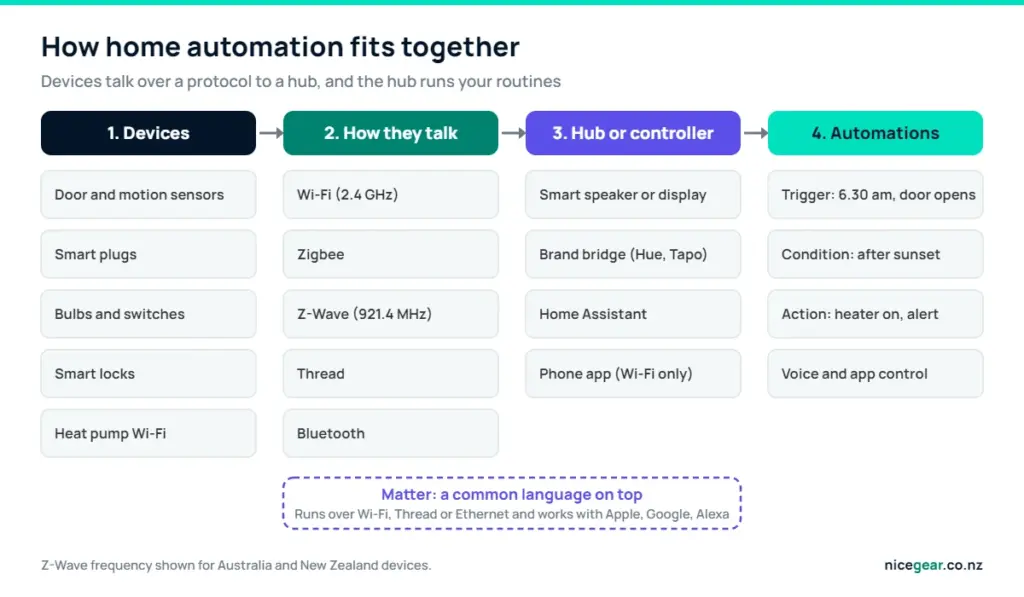
Home automation explained in four layers
Every system, from a $27 smart plug to a wired whole-house setup, has the same four layers.
- Devices do the sensing and switching: door and motion sensors, smart plugs, bulbs, locks and heat pump Wi-Fi controllers.
- Protocols carry the messages. Wi-Fi is the most common, while Zigbee, Z-Wave and Thread are low-power meshes built for battery sensors.
- A hub or controller translates between protocols and runs the logic. It might be a smart speaker, a brand bridge or a dedicated hub such as Home Assistant.
- Automations are the rules you set: when something happens, check a condition, then act.
Smart home automation routines worth setting up
A routine has three parts. The trigger starts it (a time, a sensor, your phone leaving home), a condition decides whether it should run (only after sunset, only on weekdays), and the action is what happens. These are the routines that earn their keep in NZ homes:
| Routine | Trigger | Action | What you need |
|---|---|---|---|
| Winter warm-up | 6.30 am on weekdays | Heat pump to 20°C, or heater on via a smart plug | Heat pump Wi-Fi control or a smart plug |
| Damp control | Bedroom humidity above 65% | Dehumidifier on until it drops | Humidity sensor, smart plug, hub |
| Leaving home | Last phone leaves | Lights and heaters off, cameras on | Speaker or hub with presence detection |
| Home after dark | Front door opens after sunset | Hallway light on | Contact sensor and smart bulb |
| Garage check | Door open at 9 pm | Phone alert | Door or tilt sensor |
| Holiday mode | Evenings while away | Lamps on and off at varied times | Smart plugs or bulbs |
Heaters are the routine to get right first, because they cost the most to run. Our smart plug guide covers which heaters work with a plug and what scheduling saves.
Automation routines that stay reliable
- Keep a plain schedule as a fallback for anything important, such as heating.
- Give devices clear names and rooms (“Bedroom 2 heater”), because voice assistants and routines rely on them.
- Avoid long chains where one routine triggers another; they are hard to debug.
- Decide what should happen after a power cut. Heaters should stay off until you choose otherwise.
- Test a new routine for a week before trusting it with anything that matters.
Zigbee vs Z-Wave vs Matter: which protocol?
Wi-Fi needs no hub and suits plugs, cameras and anything mains-powered, but it drains batteries and every device adds load to your router. Zigbee is a 2.4 GHz mesh used by bulbs and sensors from brands such as Philips Hue and Aqara; it needs a coordinator, and mains-powered Zigbee devices relay signals for the rest. Z-Wave uses a sub-GHz band, 921.4 MHz in Australia and New Zealand, which travels well through walls; it is common in locks and sensors but you must buy the AU/NZ version. Thread is a newer IPv6 mesh built for battery devices, and it’s the low-power option Matter uses.
| Protocol | Needs a hub? | Mesh? | Battery life | Best for |
|---|---|---|---|---|
| Wi-Fi | No | No (uses your router) | Poor | Plugs, cameras, heat pumps |
| Zigbee | Yes, a coordinator | Yes | Excellent | Bulbs and sensors |
| Z-Wave | Yes | Yes | Very good | Locks and sensors |
| Thread | A border router | Yes | Excellent | New Matter sensors and plugs |
| Bluetooth | No | Limited | Good | Setup and short-range locks |
What about Matter?
Matter isn’t a radio; it’s a standard from the Connectivity Standards Alliance that runs over Wi-Fi, Thread or Ethernet. A Matter device works with Apple Home, Google Home, Alexa and SmartThings, and can be shared across several at once. For beginners, “Matter over Thread” for sensors and “Matter over Wi-Fi” for plugs is a sound default, provided you have a Thread border router.
Do you need a smart home hub?
Often not. A handful of Wi-Fi devices works fine through their apps, and a recent smart speaker covers voice control and simple routines. A hub earns its place once you add battery sensors, mix brands, or want automations that don’t depend on the internet. Try the quiz:
Do I need a smart home hub?
Answer five quick questions and get a straight recommendation: no hub, your smart speaker as the hub, or a dedicated local hub.
1. How many smart devices will you have?
2. Battery sensors (door, motion, temperature)?
3. Which assistant or phones does your household use?
4. Must automations keep running if the internet drops?
5. How hands-on are you?
Thread border router lists come from Amazon and Google’s own documentation (September 2026). Prices are NZ retail where we could confirm them; Home Assistant Green is sold through Australian distributors that ship to NZ.
| Hub type | Examples in NZ | What it connects | Good for |
|---|---|---|---|
| Smart speaker or display | Google Home Speaker ($219), Echo Dot Max ($229), HomePod mini ($249) | Wi-Fi and Matter; Thread on these models | Most homes |
| Brand bridge | Philips Hue Bridge, Tapo H100 hub ($39) | That brand’s lights or sensors | One-brand setups |
| Local automation hub | Home Assistant Green (from A$279 via Australian distributors) | Almost everything, with add-on radios | Tinkerers and big setups |
A detail that catches people out: Amazon’s own list of Thread border routers includes the Echo Dot Max, Echo Show 8 (3rd gen) and Echo Hub, but not the basic Echo Dot. Google lists the Google Home Speaker, Nest Hub (2nd gen) and Google TV Streamer.
Home automation systems NZ: wireless DIY or wired
Most NZ homes go wireless: plug-in and battery devices, a speaker or hub, and apps. It’s cheap, renter-friendly and easy to change.
The alternative is a wired system such as Clipsal C-Bus or KNX, where switches, dimmers and sensors are cabled back to a central controller. These are designed and installed by electricians and specialist integrators, mostly in new builds and major renovations, and they’re very reliable but cost far more and are hard to change later.
When you need an electrician
Anything that connects to your home’s fixed wiring, including smart wall switches, in-wall relays, dimmers, doorbell transformers and outdoor lighting, is electrical work. WorkSafe lets people who own and live in a home replace switches and some fittings, but new wiring must be tested and connected by a licensed electrical inspector, and WorkSafe doesn’t recommend DIY without the skills. Tenants can’t do this work at all. For smart home wiring, use a registered, licensed electrician and ask whether your switch boxes have a neutral wire, which many smart switches need.
Planning a new build or renovation
Walls are open once, so a few extra dollars now saves a lot later:
- A neutral wire and deep boxes at every light switch.
- Cat6 Ethernet cable to camera spots, the lounge TV, the office and ceiling Wi-Fi access points.
- Power and a cable at the front door for a wired doorbell and a smart lock with a keypad.
- A central spot near the router, with power, for hubs and a network switch.
- Spare conduit from the switchboard to the ceiling space.
Home automation cost NZ
| Level | What you get | Rough cost (September 2026) |
|---|---|---|
| App control | A few smart plugs and bulbs on schedules | $50–$150 |
| Speaker-based automation | Speaker, plugs, bulbs, a couple of sensors | $190–$450 |
| Local hub setup | Home Assistant Green, a Zigbee or Thread radio, sensors | From about A$279 for the hub, plus radio and sensors |
| Wired system | C-Bus or KNX through an electrician or integrator | Quoted per job, usually a new-build budget item |
Security is often the next step after heating and lighting; our smart home security systems guide compares DIY kits with monitored alarms.
Common mistakes
- Buying a hub before you know what it needs to connect.
- Choosing Wi-Fi sensors for doors and windows, then replacing batteries every few months.
- Importing Z-Wave devices built for another region’s frequency.
- Relying on cloud-only routines for heating or security.
- Letting Wi-Fi coverage decide where things work; a mesh Wi-Fi system fixes most dead spots.
Our take
- Start with schedules on your biggest costs, heating first, before anything clever.
- Let a recent smart speaker or display be your first hub, and buy Matter devices where you can.
- Move to Home Assistant when you have lots of sensors or want local control.
- For new builds, spend on neutrals, deep boxes and Cat6 now; it is much cheaper than retrofitting.
- Leave anything wired to a licensed electrician.
Prices, product line-ups and platform features change often; everything here was checked in September 2026. Nicegear is independent, sells nothing and has no paid placements.
Sources and further reading
FAQs
Do I need a hub for home automation?
Not always. A few Wi-Fi or Matter devices work through their apps or a smart speaker, but battery sensors, mixed brands and offline automations are much easier with a hub.
What is the difference between Zigbee, Z-Wave and Matter?
Zigbee and Z-Wave are low-power mesh radios that need a hub, with Z-Wave using 921.4 MHz in NZ. Matter is a standard that runs over Wi-Fi or Thread so devices work across Apple, Google and Alexa.
How much does home automation cost in NZ?
App-controlled plugs and bulbs start at about $50, a speaker-based setup runs $190–$450, and a Home Assistant hub starts from about A$279 before radios and sensors. Wired systems like C-Bus or KNX are quoted per job.
Do I need an electrician for smart home automation?
Only for anything wired into your home’s circuits, such as smart switches, in-wall relays and dimmers. Plug-in and battery devices are DIY.
What is the best home automation system in NZ?
For most homes, a recent smart speaker plus Matter devices is the simplest system. Tinkerers and larger setups get more from Home Assistant, while wired systems like C-Bus or KNX suit new builds with an integrator.
Can home automation work without the internet?
Some of it can. Local hubs such as Home Assistant run automations on your own network, and Matter, Zigbee and Thread devices can keep working locally, but cloud-based routines and remote access stop until the connection returns.
Can I use Z-Wave devices bought overseas in NZ?
Only if they are built for the Australia and New Zealand frequency of 921.4 MHz. European and US Z-Wave devices use different frequencies, so buy the AU/NZ version.


