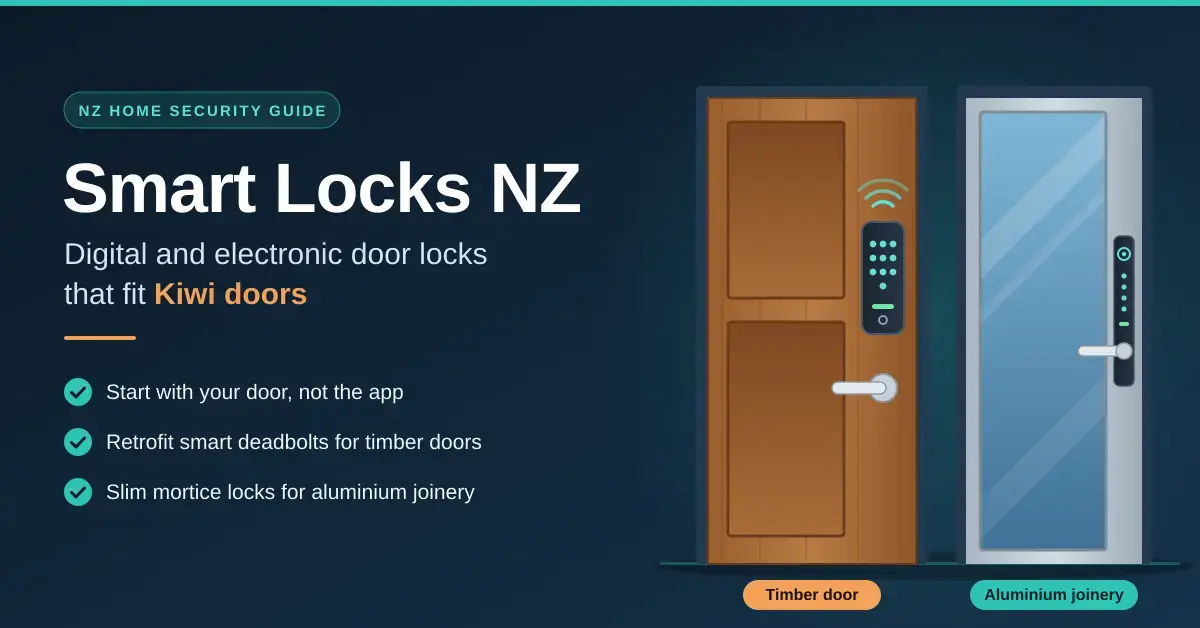
The right smart lock for a New Zealand home depends on the door, not the app. Most timber doors with a deadbolt take a retrofit smart deadbolt such as the Eufy Smart Lock C34 (about $299), while narrow aluminium joinery needs a slim smart mortice such as the Yale Unity Slim smart lock ($999–$1,098 through Yale’s own store, and less at some retailers) — all prices checked in September 2026. This guide is written for homeowners and renters choosing a digital or electronic door lock, and it starts where every sensible decision starts: with the door itself.
A smart lock is only one layer of home security, so it works best alongside door sensors and a camera. Our smart home security systems guide covers the wider setup, and the beginner’s guide to smart home devices explains how everything talks to each other if you are new to this.
Key takeaways
- Identify your door and lock first: deadbolt, mortice or narrow-stile aluminium joinery each need a different style of smart lock.
- Retrofit smart deadbolts start around $299; smart-ready Yale deadbolts and levers $418–$458; digital mortice locks $565–$730; aluminium-joinery models about $1,000.
- Most smart locks fit doors 35–60 mm thick — measure the backset and thickness before you buy.
- Batteries last months, not years, so pick a lock with a physical key override or emergency USB-C power.
- Renters need the landlord’s written consent before changing a lock.
Smart lock vs digital door lock vs electronic door lock
The three terms overlap, and New Zealand retailers use them loosely, which makes shopping confusing. The simplest way to keep them straight: every smart lock is electronic, but not every electronic lock is smart. A smart lock is an electronic lock you can control and monitor from a smartphone — the extra app, logs and remote access are what earn it the word “smart”.
| Term | What it usually means | Connectivity | Example sold in NZ |
|---|---|---|---|
| Electronic door lock | A motorised lock opened by a code, card or fob instead of only a key | Often none | Keypad and card-access locks |
| Digital door lock | A keypad or PIN lock, often a mortice lock with a keypad built in | Sometimes Bluetooth, or a “smart-ready” module | Yale YDM3109A digital mortice |
| Smart lock | An electronic lock with app control, access logs and remote access | Bluetooth, Wi-Fi, Matter, Zigbee or Z-Wave | Eufy C34, Yale Unity Slim |
Choosing a digital or electronic door lock in NZ
Decide what you actually need before you spend anything. If you only want keyless entry, a keypad-only digital lock does the job without an app or an account, and it is usually cheaper. If you want to let people in remotely, get alerts, or see who came and went, you need a proper smart lock with an app. Either way the fit rules below are identical, so start with the door and work back to the features.
“Smart-ready” is a label worth decoding. Yale uses it for locks that work as keypad locks straight out of the box and only become app-controlled when you add a Yale connectivity module — and, for control while you are away from home, a separate hub. Budget for those extras rather than assuming the base price buys full remote access.
Which smart door lock fits NZ doors?
Two measurements decide most of it, so grab a tape measure before you shop. The backset is the distance from the door edge to the centre of the key or handle, and the door thickness is usually 35–60 mm for the locks below. Get those two numbers and you can rule most models in or out in seconds.
Timber doors with a deadbolt
This is the easiest upgrade of the lot. A deadbolt with a standard 60 or 70 mm backset can take a retrofit smart deadbolt that reuses the existing holes, often fitted in under an hour with nothing more than a screwdriver. The keypad and motor sit on the inside, and the outside keeps its familiar look. If your front door already has a separate deadbolt above the handle, you are in the best-case scenario for a cheap, tidy retrofit.
Timber doors with a mortice lock
A mortice lock sits in a pocket cut into the edge of the door, with the handle and cylinder on the same plate. A digital mortice lock replaces the whole lock body and handles, so the new unit has to match your existing pocket and backset exactly. Because the fit is unforgiving, a locksmith is usually the right person to measure and install it, especially if the pocket needs enlarging.
Aluminium joinery doors
Aluminium joinery is common on New Zealand homes built since the 1970s, and it is the case that trips people up most. These doors have narrow frames and short backsets, often 23–30 mm, so a standard smart deadbolt simply will not fit. You need a narrow-stile lock designed for the profile. Yale lists the Unity Slim for aluminium joinery with 30, 40, 50 and 60 mm backset options for doors 35–60 mm thick; very short 23–25 mm backsets should be confirmed with a locksmith before you buy.
Ranch sliders and security screen doors
Most smart locks are built for hinged doors, not sliders. For a ranch slider, the practical answer is to keep its mechanical lock, add a door sensor so you know when it opens, and put the smart lock on your main hinged entry door instead. Security screen doors use their own lock bodies, so standard smart deadbolts rarely fit them; ask a locksmith or your screen installer for a digital lock made for your frame.
Which smart lock fits your door? A quick match
Once you know your door type, current lock and backset, this table points you to the style of lock that fits and who should install it. Match your situation to a row before you look at brands.
| Your door and lock | Style that fits | Examples in NZ | Who fits it |
|---|---|---|---|
| Timber, deadbolt, 60–70 mm backset | Retrofit smart deadbolt | Eufy C34, Yale Assure Lock SL | Usually you |
| Timber, mortice lock in the door edge | Digital mortice lock | Yale YDM3109A, Schlage Omnia | Locksmith |
| Aluminium joinery, short 23–30 mm backset | Narrow-stile smart mortice | Yale Unity Slim | Locksmith |
| Rim lock or night latch on the inside face | Smart deadbolt (new holes needed) | Eufy C34, Yale Assure SL | Locksmith |
| Ranch slider (sliding door) | Keep the lock, add a sensor | Door/window sensor | You or locksmith |
| Security screen door | Screen-door-specific digital lock | Frame-specific models | Locksmith or installer |
Not sure what you have? Open the door and look at the edge. One round bolt plate with a separate handle usually means a deadbolt; a tall plate carrying both the latch and the bolt is a mortice lock; a box on the inside face is a rim lock or night latch. Then measure the backset from the door edge to the centre of the key.
Smart lock NZ buying guide: the best models for 2026
The table below compares the models most widely sold in New Zealand, by what they open with, how they connect and roughly what they cost. Prices move around and several Yale models showed as out of stock on Yale’s own store when we checked, so treat the figures as a September 2026 snapshot rather than a fixed price list.
Smart lock comparison
| Lock | Type | Opens with | Connects via | NZ price (Sep 2026) | Best for |
|---|---|---|---|---|---|
| Eufy Smart Lock C34 | Retrofit deadbolt | Keypad, app, key | Wi-Fi built in; Matter | ~$299 (PB Tech) | Timber deadbolt doors |
| Yale Assure Lock SL | Digital deadbolt, smart-ready | Touch keypad; app with a Yale module | Module needed | ~$418 (Bunnings) | Deadbolt doors in a Yale setup |
| Yale Assure Lock lever | Keyed digital lever, smart-ready | Keypad, key; app with a module | Module needed | ~$458 (Bunnings) | Doors with lever handles |
| Yale YDM3109A | Digital mortice, smart-ready | PIN, card, key, app | Bluetooth (via module) | $565–$730 | Timber mortice doors |
| Yale Unity Slim | Narrow-stile smart mortice | Keypad, app | Bluetooth; Wi-Fi via Yale hub | $999–$1,098 | Aluminium joinery |
| Schlage Omnia | Fire-rated smart mortice | PIN, fingerprint, app, key | Bluetooth; Wi-Fi via BZ100 bridge | Through suppliers | Apartments and fire doors |
Yale smart lock NZ range
Yale is one of the most widely stocked lock brands in New Zealand, which makes parts and support easy to find. The Yale Unity Slim, part of the Yale Unity range, uses a four-point locking mortice designed for aluminium joinery: the latch, the deadbolt and two shootbolts all engage when you lift the handle. It runs on four AA batteries for about a year, carries an IP55 weather rating, and has USB-C emergency power, door-position sensing and a tamper alarm. It connects over Bluetooth out of the box, with Wi-Fi, Alexa and Google Home added through the separate Yale Connect Plus Hub 2. The list price is $999–$1,098 at Yale’s own store, though several New Zealand retailers sell it for less. The cheaper Assure deadbolt and YDM digital locks are smart-ready and need a Yale module before they will talk to an app.
Schlage smart lock NZ option
The Schlage Omnia is a fire-rated smart mortice lock, which is what makes it worth a look for apartment entry doors, where the door often has to be fire-rated. It supports up to 150 custom PIN codes plus 150 scheduled codes, has a fingerprint reader, works with the Schlage Breeze app, Google Assistant and Alexa, and fits doors 35–60 mm thick. Built-in alarm technology senses tampering at the lock. Wi-Fi needs the separate BZ100 bridge, and because it is a fire-rated product you should confirm compatibility with your fire-door manufacturer before fitting it. It is sold through hardware suppliers rather than the big-box stores.
Eufy smart lock
At around $299, the Eufy Smart Lock C34 is the cheapest easy retrofit we found (it is sometimes discounted lower — about $201 at Noel Leeming when we checked, versus $299 at PB Tech). It has Wi-Fi built in with no bridge required, supports Matter, Apple Home, Google Home, Alexa and SmartThings, runs on eight AA batteries for up to eight months at around ten uses a day, and keeps a physical key as backup. Its New Zealand listing says it fits standard Australian and New Zealand doors without drilling. If you already run Eufy cameras, see our Eufy security camera guide. Any Wi-Fi lock needs a decent signal at the front door, so a mesh Wi-Fi system helps if your coverage is weak there.
How much does a smart lock cost in NZ?
Expect to spend from about $300 for a basic retrofit to over $1,000 for aluminium joinery. The gap comes down to the door: the harder the lock is to fit, the more you pay for the hardware and the labour. These were the going rates in September 2026:
- Retrofit smart deadbolts (timber): from about $299 for the Eufy C34, sometimes discounted to around $200.
- Yale digital deadbolts and lever locks (smart-ready): roughly $418 for the Assure Lock SL and $458 for the Assure lever at Bunnings, plus the cost of a Yale module for app control.
- Digital mortice locks (timber): about $565 for the Yale YDM3109A at Bunnings, or $730 through Yale’s own store.
- Narrow-stile smart mortice (aluminium joinery): the Yale Unity Slim at $999–$1,098 from Yale, less at some retailers.
- Locksmith installation: budget extra for mortice, aluminium or any job that needs new holes.
Smart lock installation NZ: DIY or locksmith?
A retrofit smart deadbolt on a timber door is a reasonable DIY job when the holes and backset already match. Everything else — mortice locks, aluminium joinery and anything that needs new holes drilled — is locksmith territory. The reason is mechanical, not fussiness: a bolt that sits even slightly out of line makes the motor strain every time, which drains the batteries fast and can eventually jam the lock shut.
Most smart locks run on batteries and need no electrician at all. Electric strikes and mains-powered access-control systems are a different matter: that is fixed electrical work, and WorkSafe limits what a homeowner may do, so use a registered, licensed electrician or a security installer who works with one.
Whoever fits it, check three things before you call it done: the door closes without needing a push, the bolt slides fully home without scraping the strike plate, and the lock’s calibration or door-position sensor is set up in the app. Skipping that last step is the usual cause of a lock that reports the wrong status.
Batteries, outages and lock-outs
Plan for flat batteries and dropped internet, because both will happen at some point. The good news is that a well-chosen lock handles both without leaving you stranded.
- Expect months, not years: Yale quotes about a year on four AAs for the Unity Slim, and Eufy up to eight months on eight AAs for the C34.
- Replace the batteries when the app or the lock warns you, not when it stops working.
- Choose a lock with a physical key override or emergency USB-C power so a flat battery never locks you out.
- If the internet drops, keypads and Bluetooth keep working; only remote access and notifications stop.
A key override keeps a mechanical cylinder in the door, and any cylinder can be picked given the right tools, so buy a lock with a good-quality cylinder rather than treating the mechanical key as an afterthought.
Are smart locks secure?
A lock is only as strong as the door and frame it is fitted to, so start there. Long screws into the frame, a solid strike plate and a sturdy door matter as much as the lock itself — a $1,000 smart lock on a flimsy jamb is still a flimsy door. On the digital side, use a strong, unique password and two-factor sign-in on the lock’s app, install firmware updates when they appear, and give visitors their own time-limited codes instead of sharing yours. Tamper alarms, like those on the Unity Slim and the Omnia, warn you of forced-entry attempts.
Pair the lock with a video doorbell or a camera at the entrance, as our home security camera guide explains, so you can see who you are letting in. Locks that speak Matter, Zigbee or Z-Wave can also join automated routines — locking up at night, for example — through a hub such as Home Assistant or your smart speaker; our home automation explainer shows how those routines are built.
Smart lock for rental properties
Renters need the landlord’s written consent before changing a lock. Keep the original lock in a safe place so you can refit it when you leave, because Tenancy Services expects the property to be returned in substantially the same condition — the rules on tenants making changes to the property set out how to ask and what counts as a minor change.
For landlords, scheduled codes make tradesperson access easy and there are no keys to cut or collect. A code does not change the entry rules, though: landlords still have to give tenants proper notice before entering, exactly as they would with a mechanical key.
Common mistakes
- Buying before measuring the backset and door thickness — the single most common cause of a returned lock.
- Choosing a standard deadbolt model for aluminium joinery, where only a narrow-stile lock fits.
- Forgetting that “smart-ready” means an extra module, and a separate hub for remote control.
- Buying parallel imports built for other markets, which may not suit local door hardware and can be harder to fix under warranty.
- Ignoring low-battery warnings until the lock will not open.
Prices, stock and product line-ups change often; everything here was checked in September 2026. Nicegear is independent, sells nothing and takes no paid placements, so treat this as a starting point and confirm the current price and fit with the retailer or a locksmith before you buy.
Sources
Frequently asked questions (FAQ)
What is the best smart lock in NZ?
It depends on your door. For a timber door with a deadbolt, the Eufy Smart Lock C34 (about $299) is the best value, with Wi-Fi and Matter built in. For aluminium joinery, the Yale Unity Slim is one of the few locks designed for narrow frames, and for a fire-rated apartment door the Schlage Omnia is the one to look at.
Will a smart lock fit my aluminium door?
Only a lock designed for narrow-stile aluminium joinery will fit, such as the Yale Unity Slim, which Yale offers with 30, 40, 50 and 60 mm backsets for doors 35–60 mm thick. Standard smart deadbolts made for timber doors will not fit the narrow frame, so check the backset before buying.
How much does a smart lock cost in NZ?
In September 2026, retrofit smart deadbolts started at about $299 (sometimes discounted lower), Yale’s smart-ready deadbolts and lever locks ran roughly $418–$458 at Bunnings, digital mortice locks about $565–$730, and the aluminium-joinery Yale Unity Slim $999–$1,098. Locksmith installation is extra for anything but a straight deadbolt retrofit.
Do I need a locksmith to install a smart lock?
Not for a retrofit deadbolt that reuses your existing holes — that is a screwdriver job most people can do themselves. Mortice locks, aluminium joinery and anything that needs new holes drilled are best fitted by a locksmith, because a misaligned bolt strains the motor and drains the batteries.
What happens if the batteries go flat or the internet drops?
Most locks warn you well before the batteries run out, and many have a physical key override or emergency USB-C power so a flat battery never locks you out. Without internet, the keypad and Bluetooth still work as normal; only remote access and notifications stop until the connection returns.