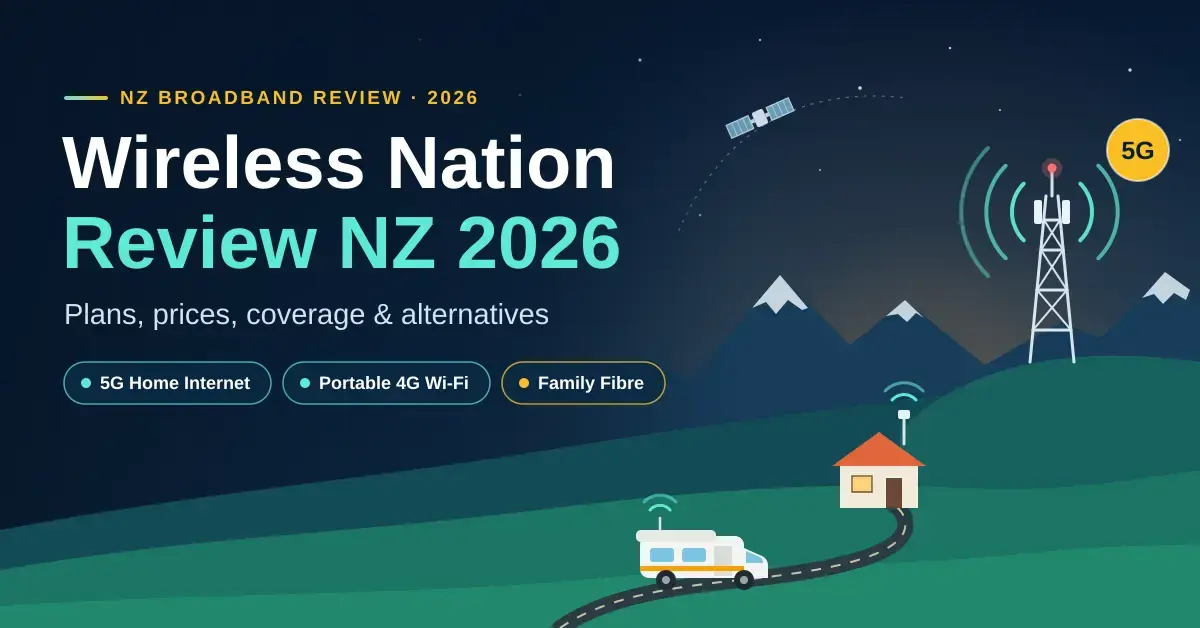
Wireless Nation built its name connecting rural New Zealand back when fibre was still a big-city luxury, and in 2026 it sells a very different mix: 5G home internet on One NZ’s network, portable 4G Wi-Fi aimed at motorhomes and baches, and three “Family Fibre” plans with parental controls. This guide lays out exactly what each plan costs over a year once the modem is counted, what speeds the company itself quotes, who each option suits, and how it stacks up against Starlink, the big ISPs and other wireless providers.
Every price and speed below is taken from Wireless Nation’s own plan pages in September 2026, and they change often, so treat the figures as a snapshot rather than a permanent quote. For the satellite alternative, our Starlink price guide keeps the current New Zealand numbers.
Key Takeaways
- 5G Home Internet is the standout at NZ$75 a month unlimited, with One NZ-tested average peaks of 316/37 Mbps, but the modem costs NZ$299 on a 12-month term (NZ$499 open term).
- Family Fibre runs NZ$79.99 to NZ$119.99 a month with a free Plume SuperPod on a 12-month term; the parental controls that make it “family” cost NZ$9.99 a month extra.
- Portable WiFi (4G) is for motorhomes, baches and renters who move: NZ$89.99 for 300 GB or NZ$129.99 unlimited, with a NZ$329 modem and average peak speeds of only 44/17 Mbps.
- Wireless Nation resells the national networks (One NZ mobile, Chorus and local fibre); its edge is New Zealand-based support and packaged hardware, not a network of its own.
- Off the 5G footprint and with no fibre, compare the 4G plan with Starlink before signing; on speed Starlink usually wins, on cost it depends on how long you stay.
Who Wireless Nation is in 2026
Wireless Nation is an Auckland-based internet service provider (ISP) that started in rural wireless and satellite and now pitches at “every Kiwi” with a mix of fibre, 5G fixed wireless, portable 4G and mobile plans. An ISP is simply the company that sells you your internet connection. Its fixed-wireless and portable services run on One NZ’s mobile network, while its fibre plans use the same Chorus and local fibre company lines that every other ISP resells. In other words, Wireless Nation does not own a network of its own; what you pay a premium for is the packaging, the parental-control app and New Zealand-based support. The useful question, then, is whether that bundle is worth more than a budget ISP riding the exact same wires or cell towers.
Quick Facts
| Provider | Wireless Nation (Auckland-based ISP) |
|---|---|
| Networks used | One NZ mobile (5G/4G); Chorus and local fibre companies |
| Services | Fibre, 5G fixed wireless, portable 4G/5G Wi-Fi, mobile |
| Cheapest unlimited | 5G Home Internet — NZ$75/month |
| Contract options | 12-month term (modem discount) or open term |
| Shipping | NZ$16.95 per order |
| Official site | wirelessnation.co.nz |
What do Wireless Nation plans cost?
The headline monthly prices range from NZ$75 to NZ$129.99, but the true first-year cost depends heavily on the modem, which is a purchase rather than a rental on the wireless plans. The table below shows each plan’s monthly charge, the speed Wireless Nation quotes, the data allowance, the hardware cost and a rough first-year total on a 12-month term (including one modem and NZ$16.95 shipping, with promotions excluded).
| Plan | Monthly | Quoted speed | Data | Hardware | First year (12-month term) |
|---|---|---|---|---|---|
| Family Fibre Saver | NZ$79.99 | 105/26 Mbps average | Unlimited | Plume SuperPod free on 12-month term (NZ$199 open term) | about NZ$977 |
| Family Fibre Boost | NZ$99.99 | 511/110 Mbps average | Unlimited | As above | about NZ$1,217 |
| Family Fibre Max | NZ$119.99 | 882/505 Mbps average | Unlimited | As above | about NZ$1,457 |
| 5G Home Internet | NZ$75 | 316/37 Mbps average peak (One NZ testing) | Unlimited | 5G-H153 modem NZ$299 on 12-month term, NZ$499 open, + NZ$16.95 shipping | about NZ$1,216 |
| Portable WiFi 300GB | NZ$89.99 | 44/17 Mbps average peak (4G) | 300 GB, then 1.2 Mbps | 4G modem NZ$329 (NZ$100 off on a 12-month term) + NZ$16.95 shipping; 5G modem NZ$499 | about NZ$1,326 |
| Portable WiFi Unlimited | NZ$129.99 | 44/17 Mbps average peak (4G) | Unlimited | As above | about NZ$1,806 |
Two costs hide behind the headline prices. First, the Plume app that provides the parental controls on Family Fibre is NZ$9.99 a month on top of the plan, so the feature that makes it “family” is an add-on. Second, the portable plans’ modem is a NZ$329 purchase, not a rental, which makes a short stay expensive per month. At the time of writing, promotions included one free month on fibre with a sign-up code and NZ$100 off the portable modem on a 12-month term; those offers come and go, so check the current Family Fibre plans, 5G Home Internet plan and Portable WiFi plans pages before you commit.
Which Wireless Nation plan fits you?
Start from what is available at your address, not from the price, because the connection type decides most of the outcome. The logic is short: get fibre if you can, take 5G if you can’t get fibre but have coverage, and keep the portable 4G plans for people who genuinely move around.
If fibre is available at your address
Choose a Family Fibre plan by how much you upload, not just download. Saver’s 105/26 Mbps suits one or two people who stream and browse; families running several video calls at once want Boost (511/110 Mbps); heavy home offices and big-file uploaders want Max (882/505 Mbps) for its 505 Mbps upload. The modem is free on a 12-month term, so fibre is where the term deal is easiest to justify.
If you can’t get fibre but have One NZ 5G
The NZ$75 unlimited 5G Home Internet plan is the standout for non-fibre homes inside coverage. It is fixed to your address and quoted at 316/37 Mbps average peak by One NZ. The catch is the modest 37 Mbps upload and the NZ$299 modem, so it pays to stay long enough to spread that hardware cost across many months.
If you move around, or have 4G only
Portable WiFi is a 4G service built for motorhomes, baches and renters who relocate, not for a fixed rural home. At 44/17 Mbps average peak it handles one or two HD streams, and the 300 GB plan drops to an unusable 1.2 Mbps once the cap is spent. For a permanent rural address with no fibre or 5G, compare it against Starlink first (see the speeds section below).
How to work out the real first-year cost
Add twelve months of the plan price, one modem at the relevant term price, NZ$16.95 shipping and — on fibre — the NZ$9.99 Plume app if you want it, then subtract any promotion. That total, divided by the number of months you expect to stay, is the honest per-month figure. It is the reason a NZ$89.99 portable plan can cost more over a year than NZ$75 5G or NZ$79.99 fibre once the NZ$329 modem is folded in.
What are the real-world speeds and coverage?
Fibre speeds are fixed by the Chorus or local fibre company line, not by Wireless Nation, so the quoted 105, 511 and 882 Mbps averages match any other ISP selling the same tiers. The 5G service is where the company’s own numbers deserve a careful read: 316/37 Mbps is an average peak measured by One NZ, and the plan page states plainly that speed varies with location, modem placement and the age of your devices, and that coverage “cannot be guaranteed at all times”. A window facing the nearest cell site and a modem kept away from foil-backed insulation make a large difference, and so does the time of day, because the cell is busiest in the evening.
The portable 4G plans quote 44/17 Mbps average peak. That is fine for one or two HD streams and video calls but not for a whole household, and the 300 GB plan’s post-cap 1.2 Mbps will not sustain video at all. Wireless Nation quotes coverage from 1,750-plus cell sites reaching about 99 percent of the population; the missing one percent is exactly the remote land the original Wireless Nation served, and there Starlink is now the usual answer, as covered in our Starlink NZ guide. To sanity-check any provider’s claims against independent testing, the Commerce Commission publishes the Measuring Broadband New Zealand programme.
Contracts, modems and exit fees
The choice between a 12-month term and an open term is really a choice about the modem. The term buys the hardware discount; the open term keeps you free to leave but charges full price for the modem. The key terms are:
- 12-month term or open term. The term unlocks the modem discount — a free Plume SuperPod on fibre, NZ$200 off the 5G modem, and NZ$100 off the portable modem.
- Early exit fee on a term is one-twelfth of the modem discount for each remaining month, plus the value of any promotion you received. Leaving a 5G plan after six months, for example, costs roughly NZ$100 plus any free-month promotion.
- Open-term pausing on the wireless plans needs five working days’ notice after a one-month minimum activation, which suits bach owners who only need the connection part of the year.
- The hardware is yours. The 5G-H153 modem and the portable 4G unit are purchases, not rentals, so you keep them; a portable mesh unit can be reused as an ordinary access point later.
- 5G Home Internet is fixed to the address. It is transferable if you move within coverage, but it is not the portable product and will not roam with you.
If you are also retiring an old copper line, Chorus explains the process in Moving off copper: your options.
Wireless Nation vs Starlink and the big ISPs
The right comparison depends entirely on what reaches your address. Inside fibre areas the fibre plans compete with dozens of ISPs; outside them the fight is between 5G, Starlink and 4G. The table sets the three broad options side by side.
| Feature | Wireless Nation 5G | Starlink Residential | Big-ISP fibre (Spark, One NZ, 2degrees) |
|---|---|---|---|
| Availability | One NZ 5G footprint, mostly towns and fringes | Anywhere with a clear view of the sky | Fibre areas (UFB passes about 87% of premises) |
| Typical speed | Tens to a few hundred Mbps, cell-dependent | Roughly 150–300 Mbps | Plan speed, delivered reliably |
| Latency | 20–60 ms | 25–60 ms | Under 10 ms |
| Upfront hardware | NZ$299–$499 modem | Kit price varies with promotions | Usually free modem on a term |
| Best for | Non-fibre homes inside 5G coverage wanting cheap unlimited data | Rural homes beyond 5G | Anyone who can get it |
If fibre is at your address, Wireless Nation’s fibre is a fair mid-market choice with a family angle, but the identical line is sold by many ISPs and the cheaper ones run NZ$10–$25 a month less for the same speeds. If you cannot get fibre but sit inside One NZ 5G coverage, the NZ$75 unlimited plan is genuinely competitive, with the modem cost as the only real catch. Beyond 5G, Starlink is faster than the 4G portable plans, which are best kept for people who move. Whatever you choose, the router behind it matters, so see our modem router guide, and gamers should read our notes on lowering ping and lag before betting on any wireless link.
How to get the best out of a wireless connection
A wireless plan lives or dies on placement and settings, so a little effort before you sign can turn a marginal signal into a solid one. The essentials:
- Test before you commit. Run a speed test on a One NZ phone at the exact spot the modem will live, at about 8 pm, before spending NZ$299 on hardware.
- Place the modem high and at a window facing the cell site, away from foil insulation and metal cladding. An external antenna kit can lift a marginal site from unusable to fine.
- Keep the wireless modem as the router and add a mesh system in access-point mode if the house needs more coverage; our mesh Wi-Fi guide explains how.
- Turn on QoS to protect the modest upload so video calls stay steady when someone backs up photos; our guide to Quality of Service and our router settings guide cover the settings.
- Measure regularly with our NZ speed test, because wireless speeds drift as cells get busier over time.
Common mistakes to avoid
Most disappointment with Wireless Nation comes from a handful of avoidable errors rather than from the service itself. Watch for these:
- Comparing monthly prices, not first-year totals. The NZ$329 portable modem and the 5G modem quietly make the “cheap” wireless plans dearer than fibre over twelve months.
- Buying 5G on faith. Coverage “cannot be guaranteed”, so a home that looks inside the footprint on a map can still test poorly at the modem’s actual spot.
- Expecting the portable plan to run a household. At 44/17 Mbps it is a travel and single-user product, and the 300 GB cap throttles to 1.2 Mbps.
- Paying for Plume you won’t use. The NZ$9.99 parental-control add-on is optional; skip it if you don’t need the controls.
- Overpaying for fibre. Since the line is identical across ISPs, paying a Wireless Nation premium only makes sense if you value its support and family features.
- Signing a term you might break. Exit fees claw back the modem discount plus promotions, so choose the open term if your plans are uncertain.
Our verdict on Wireless Nation
Wireless Nation is a solid mid-market reseller whose best product is its 5G Home Internet plan, not its fibre. The short version:
- The 5G Home Internet plan is the one worth a look: NZ$75 unlimited is good value if a One NZ signal test at your address passes and you will stay long enough to amortise the modem.
- Family Fibre is fine but not cheap; shop the same speeds elsewhere unless you specifically want the Plume parental controls and local support.
- Portable WiFi suits motorhomes and baches, not a fixed rural home, where Starlink usually wins on speed.
- Read the hardware and exit-fee terms before signing, because that is where the true cost sits.
Looking further afield on our network: if you are also weighing up entertainment options for a rural connection, see casino-apps.nz/casino/royal-vegas.
Disclaimer: Plan names, prices, speeds and terms are taken from Wireless Nation’s website in September 2026 and change without notice; promotions were excluded from the year-one totals. Nicegear has no commercial relationship with Wireless Nation or any ISP and carries no paid placements. Do the maths for your own address and usage before committing.
Sources
Frequently asked questions (FAQ)
Is Wireless Nation a good ISP?
It is a mid-market reseller with New Zealand-based support and a strong 5G home plan at NZ$75 unlimited. Its fibre costs more than budget ISPs for the same speeds, and its portable 4G plans are only good value for people who move around.
What network does Wireless Nation use?
Its 5G and portable 4G services run on One NZ’s mobile network, and its fibre plans use the Chorus and local fibre company networks that every New Zealand ISP shares.
How much does Wireless Nation 5G cost?
NZ$75 a month for unlimited data in September 2026, plus a 5G modem at NZ$299 on a 12-month term or NZ$499 open term, and NZ$16.95 shipping. That works out to about NZ$1,216 for the first year on a term.
Is Wireless Nation better than Starlink?
Inside One NZ 5G coverage the NZ$75 5G plan is usually cheaper, with similar latency and comparable speeds at a good site. Outside 5G coverage, Starlink is faster than the 4G portable plans and works anywhere with a clear view of the sky.
Does Wireless Nation still do rural wireless broadband?
Its current line-up is 5G home internet, portable 4G, fibre and mobile plans on the national networks. If your address has neither fibre nor 5G, ask them directly about options and compare Starlink and the regional wireless ISPs.