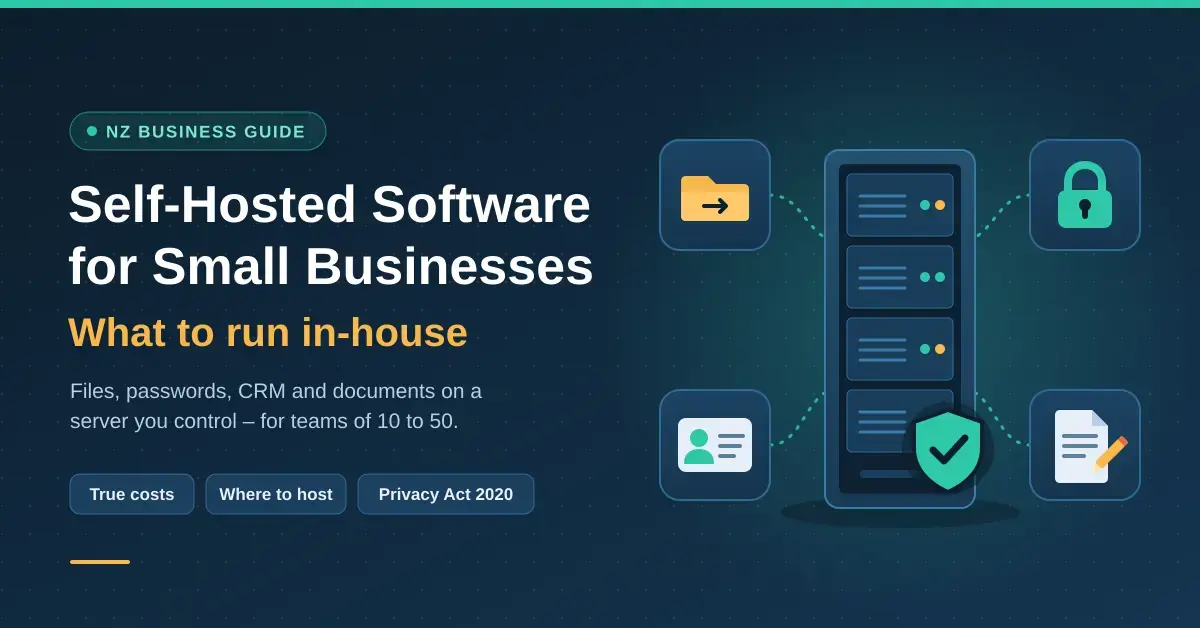
Self-hosted software for a small business means running the tools your team relies on — file sharing, passwords, a CRM, document editing — on a server you control, rather than renting each one per user from a vendor. For a New Zealand business of roughly 10 to 50 people it can trim monthly subscriptions and keep client data close to home, but it only works when someone has the time and the skills to keep the server patched, monitored and backed up.
This guide is written for owners and office managers weighing up ongoing subscriptions against bringing software in-house. It explains which tools are worth self-hosting, what the switch really costs once IT time is counted, where the server should live, and what the Privacy Act 2020 expects of you. If servers are new to you, our home server deployment guide covers the hardware side, and the open-source software hub rounds up the wider catalogue of free tools.
Key points
- Self-host the tools that cost the most per user or hold sensitive data — files, passwords, documents and CRM. Keep email and accounting with specialist cloud services.
- IT time decides the maths. For a 10-person team paying a contractor, self-hosting often costs more over three years; at around 25 users, or with skills in-house, it usually saves money.
- The Privacy Act 2020 does not force most businesses to keep data in New Zealand, but you stay responsible for information you put in the cloud and must report serious breaches.
- Microsoft (December 2024) and AWS (September 2025) both run cloud regions in New Zealand, so you can keep a self-managed server onshore without hardware in the office.
- Follow the 3-2-1 backup rule and test a full restore every quarter.
What Counts as Self-Hosted Software for a Small Business?
Self-hosted software is any application your business installs, updates and backs up itself, instead of a vendor doing all of that for you. It can run on a physical server in the office or on a virtual server you rent from a cloud provider; either way, you hold the data and control the configuration. Software as a service (SaaS) is the mirror image: you pay a fee per user each month and the vendor runs, secures and maintains everything.
Most tools people self-host are open-source business software — free to install and use, with optional paid support if you want a safety net. Going open source removes the licence fee, but not the running costs: someone still has to apply updates, watch for problems and make sure backups work. It is worth noting that the word “self-hosting” also has a second, unrelated meaning in software engineering, where it describes a compiler that can compile its own source code; that is not what this guide is about.
Which Self-Hosted Tools Make Sense for a Small Business?
The best candidates for self-hosting are tools that charge steep per-user fees, hold sensitive information, or both. The options below are mature, widely deployed and actively maintained, so you are not betting the business on a hobby project.
| Job | Self-hosted option | What it replaces | Difficulty |
|---|---|---|---|
| Files, calendars, contacts | Nextcloud | Google Drive, OneDrive, Dropbox | Medium |
| Editing documents in the browser | Collabora Online or ONLYOFFICE, inside Nextcloud | Google Docs, Office for the web | Medium |
| Passwords | Vaultwarden (works with the Bitwarden apps) | Team password managers | Medium |
| Scanned documents and receipts | Paperless-ngx | Filing cabinets, shared drives | Easy to medium |
| Customer records (CRM) | EspoCRM, SuiteCRM or Odoo Community | HubSpot, Pipedrive and similar | Medium to hard |
| ERP and inventory | Odoo Community or ERPNext | Cloud ERP subscriptions | Hard |
| Team chat | Mattermost or Rocket.Chat | Slack | Medium |
Two jobs are almost always better left in the cloud. Email is genuinely hard to self-host: spam filtering and inbox deliverability are a moving target that can quietly send your invoices to junk folders. Accounting and payroll belong in specialist services such as Xero or MYOB, which keep pace with GST returns and payday filing to Inland Revenue. If you would rather avoid running a server at all, our round-up of free business software for NZ small businesses lists cloud tools that cost nothing.
Nextcloud vs Google Workspace and Microsoft 365
Nextcloud is the closest self-hosted equivalent to Google Workspace or Microsoft 365 for files, calendars, contacts and video calls, with in-browser document editing added through Collabora Online or ONLYOFFICE. You install it once and pay nothing per user. The trade-off is polish and convenience: Nextcloud needs looking after, while the big cloud suites are effortless, bundle email and AI assistants, and simply work — for a fee per person every month.
For New Zealand businesses, Microsoft lists Microsoft 365 Business Basic at NZ$11.30 per user per month, Business Standard with Copilot at NZ$38.00 and Business Premium with Copilot at NZ$51.80, all on annual plans and excluding GST (compare Microsoft 365 business plans). A popular hybrid keeps Business Basic for email and Teams, moves file storage to Nextcloud, and uses free desktop open-source office software such as LibreOffice — saving roughly NZ$26.70 per user each month against Business Standard with Copilot.
Self-Hosted Passwords with Vaultwarden
Vaultwarden is a lightweight, self-hosted server that works with the official Bitwarden apps and browser extensions, so your team gets a familiar password manager without a per-seat subscription. It is one of the easiest wins on this list because it is small, stable and stores only encrypted data. If your staff are still reusing passwords or keeping them in a spreadsheet, our beginner’s guide to password managers is worth reading before you roll one out.
Self-Hosted CRM and ERP
A self-hosted CRM earns its keep when per-seat pricing starts to sting or you need custom fields and workflows a hosted product will not allow. EspoCRM and SuiteCRM are the most approachable to run; Odoo Community and ERPNext go further, bundling CRM with invoicing, inventory and more in a single system, at the cost of a steeper setup. Our guide to ERP software for NZ businesses digs into the larger platforms and when they are worth the effort.
What Does Self-Hosting Actually Cost Compared With SaaS?
Licence savings are easy to see; IT time is easy to forget, and it is usually the number that decides the whole thing. The snapshot below sets both sides side by side over three years, using realistic example figures for a small New Zealand office.
Cost snapshot
| Team size | SaaS over 3 years | Self-hosted over 3 years | Outcome |
|---|---|---|---|
| 5 users | ~NZ$5,400 | ~NZ$14,700 | Self-hosting costs about NZ$9,300 more — rarely worth it |
| 10 users | ~NZ$10,800 | ~NZ$14,700 | Self-hosting costs about NZ$3,900 more over three years |
| 25 users | ~NZ$27,000 | ~NZ$14,700 | Saves about NZ$12,300 and pays back in ~11 months |
Example figures for one office server, NZ$ excluding GST, assuming the SaaS it replaces costs NZ$30 per user per month. Includes hardware, setup and admin time at NZ$120 an hour, off-site backup and power. Use your own quotes.
The assumptions behind those numbers are a single office server costing about NZ$2,500, 20 hours of setup and 2 hours of admin a month at NZ$120 an hour, NZ$25 a month for off-site backup and a few dollars of power. The pattern is clear: self-hosting rewards scale. A five-person office that has to pay a contractor almost never breaks even, because the flat monthly running cost outweighs the handful of subscriptions it replaces. A 25-person team on the same setup can pay the hardware back in under a year and save well over NZ$10,000 across three.
Two levers change the maths most. The first is head count: subscription costs grow with every user, but a server costs much the same to run whether it serves ten people or forty. The second is who does the work — set the hourly rate to your own staff’s time rather than a contractor’s and the sums tilt sharply towards self-hosting, though that time is never truly free. Choosing capable but modest hardware helps too; our comparison of a mini PC versus a laptop for a home office covers the kind of low-power machine that makes a good always-on server.
Where Should It Run: Office Server or NZ Cloud?
You have two honest options: a server on your own premises, or a virtual server rented in a New Zealand cloud region. The table below sums up the trade-offs.
| Factor | Server in the office | Virtual server in an NZ cloud region |
|---|---|---|
| Up-front cost | Hardware, typically a mini PC plus NAS and UPS | Little or none |
| Monthly cost | Power and your time | Server rental plus your time |
| Speed in the office | Local network speed | Limited by your internet connection |
| Outages | Power cuts and fibre faults take it offline | Data-centre-grade power and networking |
| Data location | Your premises | An NZ data centre, if you pick an NZ region |
An office server is usually a small, quiet mini PC running Proxmox VE, paired with a NAS for file storage and backups and an uninterruptible power supply (UPS) to ride out short power cuts. Staff working from home reach it over a VPN — a private, encrypted tunnel — such as WireGuard or Tailscale; if VPNs are new to you, our guide to VPNs in New Zealand explains the basics. A fibre plan with around 100 Mbps upload, as most Fibre 300 plans provide, comfortably serves a small team.
If owning hardware does not appeal, you can now keep a self-managed server onshore. Microsoft’s New Zealand North region opened for business in December 2024, and AWS launched its Asia Pacific (New Zealand) Region in Auckland in September 2025. Renting a virtual server in either keeps your data in New Zealand data centres — but you still patch, secure and back up the software yourself, so the admin-time part of the cost does not disappear.
Does the NZ Privacy Act Require Data to Stay in New Zealand?
No — the Privacy Act 2020 does not require most private businesses to store personal information inside New Zealand. What it does require is genuine care for the information you hold, wherever it sits. In plain terms, three duties matter most for a self-hosted setup:
- Reasonable security safeguards for the information you hold (Information Privacy Principle 5).
- Care when disclosing information to organisations overseas (Principle 12).
- Prompt notification to the Privacy Commissioner and to affected people when a breach is likely to cause serious harm.
The Office of the Privacy Commissioner’s guidance is that when a cloud provider only stores or processes information on your behalf, you remain responsible for it and it is not treated as a disclosure overseas — see its notes on sending information overseas and the overview of the Privacy Act 2020. Self-hosting does not lift that responsibility; it simply moves the security work onto your team. Some sectors, health being the obvious one, carry extra rules, so check with your professional body or adviser if that applies to you.
How Do You Secure and Back Up a Self-Hosted Setup?
Treat backups and access control as non-negotiable — they are the difference between a bad afternoon and a closed business. The backbone is the 3-2-1 rule: keep three copies of your data, on two different types of storage, with one copy off-site. For a small office that can mean the live data on the server, a nightly copy to a NAS, and an encrypted copy in cloud storage. Keep versioned or immutable backups so ransomware cannot silently encrypt them too, and test a full restore every quarter — a backup you have never restored is only a hope.
- Turn on multi-factor authentication for every self-hosted app and admin account, so a stolen password alone is not enough to get in.
- Never expose admin pages to the open internet. Put everything behind a VPN or an authenticated reverse proxy.
- Patch on a schedule, and switch on automatic security updates wherever the software supports them.
- Monitor it. A free tool such as Uptime Kuma can email or message you the moment a service goes down.
The National Cyber Security Centre’s Own Your Online site has a plain-English guide to backing up your business data that is worth sharing with the whole team.
How Do You Get Started With Self-Hosting?
Start small and prove the idea before you move anything critical. Self-hosting one low-risk tool teaches your team the habits — updates, backups, restores — that everything else depends on, so you learn on something you can afford to break.
- Pick one tool first. Vaultwarden or Paperless-ngx are ideal starters: useful, self-contained and easy to back up.
- Choose where it runs. A small mini PC for an office server, or a virtual server in an NZ cloud region if you would rather not own hardware.
- Install a hypervisor or containers. Proxmox VE or Docker keeps each app isolated, so an update to one cannot break another.
- Lock it down before anyone uses it. Put it behind a VPN, turn on multi-factor authentication, and never open the admin page to the internet.
- Set up backups on day one, following the 3-2-1 rule, and run a test restore before you trust the system with real data.
- Write it down. Record how it is configured and how to restore it, so the setup does not live only in one person’s head.
Once that first tool has run smoothly for a month or two, add the next one. Growing the stack gradually keeps the maintenance load visible and stops a single ambitious weekend turning into an unmaintained liability.
Common Self-Hosting Mistakes to Avoid
- Self-hosting email. Deliverability problems and spam filtering make it a poor trade for a small business; keep email with a specialist.
- Only one person knows how it works. Document passwords (in the password manager), network details and restore steps so a bus, a resignation or a holiday cannot lock you out.
- Counting licence savings but not IT time, which is almost always the biggest cost of running your own server.
- No UPS or spare parts, so a power cut or a failed SSD stops the whole office instead of one machine.
- Leaving Nextcloud or a CRM open to the internet without updates. Unpatched web apps are one of the most common ways attackers get in.
Who Should Self-Host, and Who Shouldn’t?
The right answer depends almost entirely on head count and in-house skill, so match the approach to the size of your team.
- Under about 10 staff: stay mostly on SaaS. Self-host one or two high-value tools, such as Vaultwarden or Paperless-ngx, only if someone genuinely enjoys looking after them.
- About 10 to 50 staff: Nextcloud plus a CRM on a Proxmox server, with a NAS and off-site backups, can save thousands a year towards the top of that range. Run your own quotes through the cost snapshot above and budget honestly for IT time.
- Whatever the size: keep email and accounting in the cloud, and treat backups and multi-factor authentication as things you never skip.
Disclaimer: Software prices and features change often. Prices were checked in September 2026 and are shown excluding GST, as the vendors list them. This article is general information, not legal or financial advice; Nicegear is independent and carries no paid placements.
Sources
Frequently Asked Questions (FAQ)
What is self-hosted software?
Self-hosted software is software your business installs and runs on its own server, either in the office or on a rented cloud server, instead of paying a vendor per user for a hosted service. You control the data and the settings, and in return you are responsible for updates and backups.
Is self-hosting cheaper than SaaS for a small business?
It depends mainly on IT time. For a small team that has to pay a contractor, self-hosting often costs more over three years, while larger teams or businesses with in-house skills usually save money, especially when they are replacing expensive per-user software.
Is Nextcloud a good alternative to Google Workspace?
Nextcloud is a strong alternative for file sharing, calendars and contacts, with browser-based document editing through Collabora Online or ONLYOFFICE. It does not include email, so most businesses pair it with a hosted email service such as Microsoft 365 or Google Workspace.
Does the NZ Privacy Act require data to be stored in New Zealand?
No, not for most private businesses. The Privacy Act 2020 requires reasonable security safeguards and care when disclosing personal information overseas, and you remain responsible for information a cloud provider stores on your behalf, wherever it is held.
What is the 3-2-1 backup rule?
Keep three copies of your data, on two different types of storage, with one copy off-site. For a small office that usually means the live data on the server, a NAS backup and an encrypted cloud copy, with regular test restores to prove the backups actually work.