Securing your home or commercial premises across Aotearoa New Zealand has undergone a profound technological shift as smart home ecosystems become standard infrastructure for safety-conscious Kiwis. For generations, traditional property defense relied on bulky, hardwired analog closed-circuit television (CCTV) systems that required invasive drilling through wall cavities and expensive professional installation fees.
The modern digital era has completely reimagined this space, with the premium arlo security camera nz marketplace leading the charge in high-performance, wire-free perimeter protection. By combining advanced low-power Wi-Fi data pipelines with cutting-edge optical lenses and cloud-assisted artificial intelligence, these sophisticated security systems allow everyday property owners to deploy an elite surveillance grid in less than an hour.
Whether you are aiming to track delivery couriers on a rainy afternoon in Auckland, protect isolated farm sheds on a lifestyle block in Hamilton, or keep an eye on a holiday bach in the Marlborough Sounds, investing in an advanced arlo camera nz network delivers unparalleled visual clarity and peace of mind. Navigating the diverse range of available hardware models, understanding the ongoing cloud subscription tiers, and identifying the perfect placement sweet spots are essential steps to tailoring an automated security system that perfectly insulates your household, assets, and lifestyle against external vulnerabilities.

- 100% Wire-Free Deployment: Eliminates permanent structural cables by utilizing high-capacity rechargeable lithium batteries and advanced local Wi-Fi transmitters.
- Evidence-Grade Resolution: Captures critical environmental details cleanly with advanced image sensor options scaling from 2K HDR up to true 4K ultra-high definition.
- Integrated Smart Spotlights: Illuminates dark perimeters instantly upon motion detection to visually deter nighttime trespassers while enabling full-colour night vision.
- Advanced Object Computer Vision: Leverages cloud-based artificial intelligence to accurately separate passing vehicles, neighborhood pets, delivery packages, and genuine human targets.
- Two-Way Noise-Cancelling Audio: Allows homeowners to converse clearly with visitors or warn off intruders straight from a smartphone application anywhere in the world.
The Technological Infrastructure Powering Arlo Security Cameras NZ
The fundamental engineering driving the modern arlo security cameras nz ecosystem centers on providing maximum computational power with minimal local hardware footprints. Traditional wireless cameras are notoriously plagued by severe battery drain, poor wireless range, and sluggish motion wake-up response times that regularly miss the most critical seconds of a security event. Arlo neutralizes these historical limitations by splitting its operational workloads into highly optimized local standby states and cloud-accelerated processing matrices. The camera’s physical chassis houses an advanced passive infrared (PIR) sensor that continuously monitors the environment for moving thermal signatures, keeping the heavy optical lens and main Wi-Fi radio completely dormant until an actual heat source crosses its field of view.
The moment the PIR sensor registers a thermal shift, the camera wakes its core processors within mere milliseconds, initializing an encrypted high-bandwidth video upload straight to secure regional servers. This highly efficient architecture ensures that a single manual charge of the internal lithium battery can comfortably sustain the device for up to six full months under standard residential usage conditions. Furthermore, because the heavy lifting of artificial intelligence shape analysis and historical video archiving is handled offsite within secure cloud centers, the physical wall-mounted cameras remain lightweight, compact, and completely resistant to local hacking or physical data theft if a trespasser attempts to smash the hardware.
The Power of Local Smart Hub Syncing
While modern iterations can connect directly to a standard 2.4 GHz or 5 GHz home Wi-Fi router, pairing your hardware grid with a dedicated local SmartHub bridge unlocks a completely separate layer of operational stability. The SmartHub creates a private, ultra-low-latency wireless network dedicated solely to your security cameras, effectively insulating your surveillance data streams from the general network congestion caused by family smartphones, gaming consoles, and streaming devices.
Evaluating the Top Arlo Camera NZ Models for Kiwi Homes
Selecting the perfect hardware configuration for your property requires a realistic assessment of your home’s structural layout, exterior lighting conditions, and baseline budget constraints. The product catalog is carefully tiered into distinct performance profiles, ensuring that whether you require an entry-level visual monitor for an indoor hallway or an elite, multi-lens weatherized shield for a sprawling commercial yard, a specialized lens configuration is readily available to execute the task.
The mainstream consumer lineup is spearheaded by three distinct families: the Essential series, the Pro series, and the flagship Ultra series. Each progressive hardware generation introduces significant leaps in absolute pixel density, field-of-view viewing angles, and advanced lens stabilization matrices that directly dictate how effectively your recorded video clips can be used as official, actionable evidence if an incident occurs on your boundary lines.
Hardware Performance Comparison Matrix
| Camera Model Series | Native Video Resolution | Maximum Field of View | Integrated Power Supply | Best Local Application Match |
|---|---|---|---|---|
| Arlo Essential 2K (Gen 2) | 2K Quad High Definition | 130-Degree Diagonal | Internal Rechargeable Battery | Front porches, suburban patios, indoor rooms |
| Arlo Pro 5S 2K | 2K HDR Optimized | 160-Degree Wide Angle | Removable XL Battery Cell | Busy driveways, exposed side alleys, carports |
| Arlo Ultra 2 4K Flagship | 4K Ultra-HD Crisp | 180-Degree Panoramic | Removable Quick-Charge Cell | Sprawling rural yards, commercial perimeters |
Choosing Between Fixed and Pan-and-Tilt Variants
While standard fixed lenses are exceptional for covering clear, predictable choke points like entrance doors or narrow driveways, wide panoramic models give you the spatial freedom to monitor massive outdoor living spaces without installing multiple separate camera bodies. The massive 180-degree viewing angle of the Ultra series utilizes advanced digital de-warping algorithms to straighten fish-eye optical distortions, ensuring your recorded perimeter edges remain perfectly proportioned and sharp.
Navigating the Financial Reality of Arlo Secure Subscription Plans
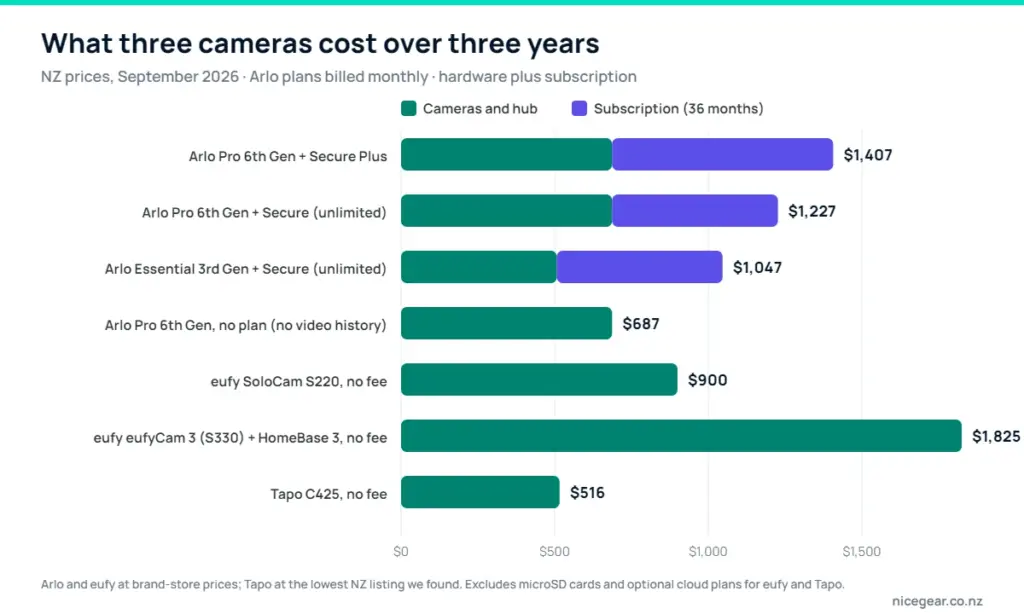
An essential aspect of the total cost of ownership that every New Zealand consumer must fully understand before purchasing security hardware is the structural requirement for an active cloud subscription. Unlike legacy closed-loop camera brands that save video clips onto localized internal memory cards for free, the entire advanced utility of the modern ecosystem is unlocked through its proprietary Arlo Secure subscription framework.
Without an active monthly plan, your cameras are strictly limited to broadcasting live video streams to your smartphone app and sending basic, non-specific motion notifications. To store historical video recordings for up to 30 days, unlock high-resolution 2K or 4K playback, and utilize advanced artificial intelligence object classification, you must select an appropriate monthly service plan. These plans operate on an open, month-to-month rolling billing cycle with absolutely no long-term contract lock-ins, giving you the flexibility to pause or adjust your coverage settings directly from your smartphone account dashboard.
Pricing Structure of Arlo Secure Cloud Plans
| Plan Subscription Tier | Monthly Cost (Single Camera) | Monthly Cost (Unlimited Cameras) | Maximum Video Storage Lifespan | Core Smart Features Included |
|---|---|---|---|---|
| Arlo Secure Basic | $4.99 NZD | $14.99 NZD | 30 Days Cloud History | 2K Video, AI Object Detection, Activity Zones |
| Arlo Secure Plus 4K | $7.99 NZD | $21.99 NZD | 30 Days Cloud History | 4K Video, Priority Cloud Streaming, Emergency Tools |
| Arlo Safe & Secure | N/A | $29.99 NZD | 30 Days Cloud History | Full 4K Tracking, Automated 24/7 Professional Monitoring |
The Power of True 4K Resolution in Modern Perimeter Security
For property owners who refuse to compromise on visual precision, deploying a premium 4K ultra-high-definition sensor array is an absolute necessity. Standard high-definition 1080p surveillance video is perfectly acceptable for checking if a courier package has been dropped on your welcome mat, but it rapidly fails when you need to analyze distant, fast-moving environmental details in the middle of a security crisis. If an unidentified vehicle pulls onto your gravel driveway at midnight, a lower-resolution lens will routinely turn the alphanumeric characters of the vehicle’s registration plate into a pixelated, unreadable blur.
The expanded physical canvas of a true 4K sensor packs four times the absolute pixel volume of traditional high-definition gear. This immense digital density hands home security operators the freedom to perform advanced digital magnification up to twelve times zoom without introducing severe pixel blockiness or image degradation. This means you can comfortably read small text printed on a trespasser’s clothing, identify exact vehicle trim lines, and hand over pristine, legally unassailable photographic files to the New Zealand Police to rapidly accelerate an investigation.
Advanced HDR Exposure Balancing
Outdoor environments across Aotearoa are notorious for extreme lighting differentials, particularly during harsh summer afternoons where a deep, dark porch shadow sits immediately adjacent to an intensely bright, sunlit concrete driveway. Standard camera sensors completely lose detail in these scenarios, either blowing out the bright areas into solid white blocks or crushing the shadowed zones into total blackness. Arlo’s integrated High Dynamic Range (HDR) processing automatically takes multiple concurrent exposures of the exact same frame, blending them instantly to preserve perfect clarity across both the blinding highlights and the deepest structural shadows.
Overcoming Environmental Factors and New Zealand Weather Extremes
Installing sensitive electronic surveillance hardware onto the exterior cladding of your home means exposing the gear to some of the most volatile and corrosive atmospheric conditions in the Southern Hemisphere. Properties nestled along the coastal bays of Auckland, Tauranga, or the Kapiti Coast must contend with continuous, airborne salt spray that can aggressively corrode inferior electrical joints and degrade low-grade consumer polymers within months. Meanwhile, homes positioned throughout Central Otago, inland Canterbury, or the central North Island volcanic plateau face massive thermal fluctuations, shifting from baking summer UV heat to freezing winter frosts down to sub-zero temperatures.
The specialized exterior housings designed across the premium lineup are engineered utilizing high-grade, UV-stabilized impact composites sealed tight against liquid and dust ingress. Holding certified industrial weatherproofing credentials, these sealed enclosures can survive torrential downpours, gale-force winds, thick morning condensation, and heavy winter snow accumulation without suffering internal moisture leaks or terminal electrical short-circuits.
Managing the Realities of Rain Fade and Lens Maintenance
Pro Installation Strategy: While the internal electronics are perfectly shielded against the elements, heavy driving horizontal rain can occasionally leave stray water droplets clinging across the curved protective optical glass lens element. These stray drops can refract light and create blurry, distorted patches in your active video recordings. Mounting your exterior cameras slightly recessed underneath wide roof soffits, deep eaves, or protective gutter gables keeps direct rain off the lens face, ensuring pristine, un-obscured surveillance streams throughout the worst winter storms.
Harnessing Local AI to Eliminate Frustrating False Alerts
One of the most tedious and disruptive aspects of owning a legacy exterior security camera is dealing with a relentless barrage of meaningless push notifications flashing across your smartphone screen throughout the day. Older motion-tracking software operates on simple pixel shifts within the frame; this means that every time a strong gust of wind blows through your backyard feijoa trees, a low-flying bird darts across the lawn, or a passing car’s headlights flash against your front fence, your phone triggers a false alarm. Over time, notification fatigue sets in, causing many homeowners to ignore alerts entirely—frequently missing the one genuine security breach that actually demanded immediate action.
To permanently resolve this operational headache, the Arlo Secure cloud engine integrates powerful, highly trained neural network processors running advanced computer vision artificial intelligence. Rather than reacting to generic raw movement, the system actively analyzes the geometric contours, speed profiles, and physical characteristics of moving objects within the video frame in real-time. This allows the system to accurately categorize what is happening on your section, giving you total control over how your mobile phone alerts you to specific movements.
Customized Alert Filtering Toggles
- Human Shape Classification: Restricts high-priority smartphone alerts strictly to events where a clear human form steps across your designated property lines.
- Vehicle Movement Logs: Tracks the entry of automobiles onto your concrete driveway or front verge, allowing you to monitor courier arrivals while completely ignoring cross-traffic on the main road.
- Animal Activity Separation: Automatically filters out the movements of the family dog, stray cats, or backyard chickens, logging them silently in the historical archive without buzzing your phone.
- Package Delivery Detection: Utilizes specialized object recognition to identify when a courier drops a box on your porch, sending a dedicated “Package Delivered” alert and monitoring the zone until the parcel is retrieved.
Upfront Hardware Costs and Real-World New Zealand Price Points
Before choosing to overhaul your property’s perimeter defenses, it is wise to establish a realistic financial blueprint for the initial hardware acquisition. Because these premium systems incorporate advanced optics, high-density lithium cells, specialized power-management chips, and sophisticated long-range dual-band wireless antennas, the initial capital investment is naturally higher than basic entry-level cameras that lock features behind poor physical build quality.
In the local retail marketplace across New Zealand, an entry-level starter kit consisting of a single wireless Essential 2K lens typically starts around the $199 to $279 mark. For households looking to deploy a robust, multi-lens perimeter shield, securing a comprehensive starter bundle consisting of three or four premium Pro 5S cameras paired with an ultra-high-performance centralized SmartHub base station will generally range between $999 and $1,499 depending on the specific video resolution profile and integrated solar capabilities selected.
Capital Investment Paths by Property Scope
Acquire a standalone wireless unit to monitor a singular, high-risk vulnerability point, such as a front door porch alcove or a tight urban garage door entrance.
Expand your perimeter defense by installing a dual-camera setup that establishes simultaneous surveillance coverage over both your primary front driveway and your hidden rear garden deck.
Deploy an integrated residential network bundle that blankets all four main structural corners of a standard freestanding suburban home, linking all video feeds to a single app interface.
Invest in a maximum-security enterprise grid featuring absolute 4K ultra-high-definition lenses, dedicated SmartHub bridges, smart biometric door locks, and high-output continuous solar charging panels.
Step-by-Step DIY Installation and Optimization Guide for Kiwis
One of the most practical and liberating benefits of adopting modern wire-free surveillance hardware is that it completely removes the need to secure a building consent or hire an expensive commercial security technician to run power lines through your home’s walls. The entire physical mounting sequence is engineered for straightforward do-it-yourself deployment, requiring only a basic home cordless drill and a few minutes of clear focus.
Before drilling permanent holes into your expensive exterior linear weatherboards, brick facings, or timber fascia boards, it is a vital best practice to perform a preliminary wireless link test. Carry your fully charged camera unit out to the exact intended physical mounting location and check the real-time live video stream on your mobile application. This simple check ensures the device can maintain a robust, high-bandwidth connection to your home Wi-Fi network before you anchor the brackets down permanently.
The Mounting and Optimization Sequence
Power Management Profiles: Manual Recharging vs. Continuous Solar Arrays
Opting for a wireless exterior surveillance setup means you must select a clear strategy for managing the battery reserves of your devices over the long term. The standard configuration relies on manual battery maintenance; the camera is mounted to the wall via a quick-release magnetic or threaded bracket, allowing you to easily unmount the hardware every three to six months, carry it indoors, and plug it into a standard smartphone USB wall charger overnight. Wikipedia
For individuals who despise the idea of scaling ladders several times a year to maintain their security gear, upgrading to an integrated or external micro-solar panel configuration is a massive upgrade. These compact, weatherized solar arrays require surprisingly little direct New Zealand sunlight to function effectively—typically needing just two to three hours of un-obscured daily exposure to fully offset the power consumed by standard motion-activated recording events, providing a completely self-sustaining, hands-free security loop year-round.
Continuous Energy Management Comparison
| Power Management System | Average Maintenance Frequency | Upfront Accessory Cost | Long-Term Operational Trade-off |
|---|---|---|---|
| Manual USB Boundary Charging | Every 3 to 6 Months | $0.00 (Included in Base Box) | Demands manual ladder work; camera goes offline during charging periods |
| Official Micro-Solar Accessory | Zero Maintenance (Self-Sustaining) | $79 – $99 per Camera Node | Full hands-free operation; keeps battery cells topped up naturally year-round |
| Hardwired Outdoor Power Cable | Zero Maintenance (Continuous Grid) | $49 – $69 per Running Line | Requires proximity to outdoor weatherproof power sockets; eliminates battery sleep lag |
Managing Wireless Interference from Common Domestic Materials
Operating a completely wire-free security network means your video data must travel cleanly through the open air via high-frequency radio waves. While air transmission is highly efficient, the physical structure and building materials of your home can act as a literal shield, dampening the signal strength and causing frustrating issues like delayed notifications, blocky video artifacts, or chronic device dropouts.
Standard timber framing and plasterboard walls present very little resistance to Wi-Fi frequencies, allowing the signal to travel across rooms easily. However, if your home features a traditional corrugated iron roof, solid concrete structural block walls, or modern low-emissivity (Low-E) double-glazed window panels, your wireless performance can drop dramatically. Understanding these structural barriers allows you to place your interior Wi-Fi router or mesh nodes strategically to maintain a clean line of sight to your outdoor security assets.
Wireless Signal Penetration Across Common Materials
- Standard Timber & Plasterboard: Low attenuation risk; high-frequency wireless signals pass through standard interior walls with minimal drop in absolute throughput.
- Low-E Double Glazed Glass: Medium attenuation risk; the metallic oxide coatings applied to modern energy-efficient windows can bounce radio waves, reducing outdoor range.
- Solid Brick & Reinforced Concrete: High attenuation risk; dense structural masonry aggressively absorbs wireless energy, requiring closer proximity to your access bridges.
- Corrugated Iron & Steel Meshing: Critical attenuation risk; sheet metals act as a literal Faraday cage, completely blocking wireless propagation and demanding strategic external routing.
Consumer Guarantees Act Protections and Local Warranty Realities
Because a comprehensive exterior wireless surveillance network represents a substantial long-term financial asset for your household, understanding your explicit legal rights as a local consumer is highly important. Any smart home security accessory, battery-powered lens, or solar base station bundle purchased directly through an authorized New Zealand retail storefront or a registered domestic online e-commerce platform is automatically protected by the strict legal frameworks of the Consumer Guarantees Act (CGA).
Under the CGA, any electronic appliance sold for domestic residential use must be of acceptable quality, function completely as advertised by the distributor, and prove durable enough to survive for a reasonable operational timeframe relative to its retail price point. If your premium wire-free camera suffers a sudden internal component failure, a terminal battery cell collapse, or a complete breakdown of its wireless transmitter within a year or two of normal domestic monitoring use, the local retail partner is legally obligated to provide a proper remedy, regardless of what is printed on a standard overseas manufacturer warranty card.
Local Warranty Safety Nets and Exclusions
Important Legal Boundary for Kiwi授 Buyers: Please note that local consumer protection laws do not cover situations where electronic hardware fails due to direct user negligence, installation blunders, or external accidents. If a camera falls off a wall because it was loosely attached to a rotten piece of timber fascia, or if an indoor-rated camera suffers catastrophic water damage after being mounted in an open, damp outdoor carport, the homeowner is fully responsible for all replacement costs.
Summary
Upgrading your property with a modern network of premium wireless security cameras represents a massive leap forward in convenience, clarity, and long-term financial efficiency for Kiwi homeowners and renters alike. By eliminating the historical requirement for invasive structural wiring and expensive commercial installation call-out fees, these sophisticated wire-free systems allow anyone to deploy an evidence-grade surveillance grid around their boundaries in a single afternoon. Whether your primary goal is to wipe out annoying false alarms using advanced localized AI face filtering, enjoy the hands-free convenience of self-sustaining micro-solar panels that keep your batteries topped up through a damp winter, or capture pristine evidence with ultra-high-definition 4K lenses, modern wireless hardware delivers exceptional performance with minimal human intervention. By matching your home’s unique building materials with the appropriate wireless standard and purchasing through authorized local retail channels backed fully by the Consumer Guarantees Act, you can easily establish a reliable perimeter shield that keeps your family, home, and privacy completely protected around the clock.
FAQ
Do Arlo security cameras require a continuous monthly plan to function?
Yes, while the cameras can stream live video to your smartphone for free, storing historical video records for up to 30 days and accessing advanced artificial intelligence shape detection features requires an active Arlo Secure subscription, starting around $4.99 NZD per month for a single camera.
How long does a standard wire-free security camera battery last on a single charge?
Under standard residential operational parameters (roughly 10 to 15 motion-activated event clips per day), a single full charge of the integrated lithium cell will comfortably power the camera node for three to six months before requiring a manual USB recharge.
Will a heavy winter rainstorm or frost cause wire-free security cameras to drop offline?
No, provided the hardware shell carries an industrial weatherproofing certification. These premium outdoor camera enclosures are built utilizing heavy-duty, UV-stabilized impact polymers and dense silicone seals that completely prevent driving rain, heavy frost, and coastal salt spray from damaging internal circuits.
Can I manually add extra video storage space to my home security setup?
Yes, if you choose to pair your wireless camera grid with a centralized hardware SmartHub base station, you can insert a high-capacity local USB flash drive or SD memory card into the rear of the hub to compile local backup video streams for free.
How does localized AI detection prevent the camera from sending endless false alerts?
Instead of reacting to basic pixel movements like a tree branch swaying in the wind, advanced computer vision AI profiles the contours and movement vector of objects within the lens frame, filtering out pets and moving street traffic before buzzing your phone.
Is it safe to leave a solar-powered security camera outside during intense summer heat?
Yes, all outdoor-rated camera hardware modules are manufactured using high-durability composites engineered to withstand intense ultraviolet radiation and running operational temperatures scaling up to 50 degrees Celsius without developing plastic degradation.
Can I monitor my New Zealand property cameras through my phone while travelling overseas?
Yes, as long as your home internet connection remains active and your wireless cameras are successfully linked to your local router, the secure mobile application allows you to stream live video feeds, review historic recordings, or adjust sensor thresholds from anywhere in the world.
What happens to my wire-free cameras if my home internet connection goes down temporarily?
If your local Wi-Fi router drops offline due to an internet provider outage, you will temporarily lose the ability to view live feeds or receive real-time push notifications. However, if your setup includes a centralized SmartHub with a local storage drive attached, the cameras will continue to record motion events locally.
Can a single wireless security camera system handle a large multi-story townhouse layout?
Yes, you can comfortably link multiple independent camera nodes to a single user account. However, because multi-story townhouses incorporate dense concrete flooring and steel framing that block wireless signals, you may need to install a mesh home network to maintain connectivity to your furthest outdoor lenses.
Are my wireless security camera equipment purchases protected under New Zealand law?
Yes, any security hardware, battery packs, or solar accessories purchased through an authorized retail store or an official online distributor within New Zealand are fully covered under the strict statutory protections of the Consumer Guarantees Act (CGA).