
Good outdoor security cameras in NZ share three things: a weather rating of IP66 or better, at least 2K resolution, and a power source that suits the spot, whether that is a cable, a battery or a solar panel. Placement matters more than megapixels. A 2K camera five metres from the front door will show a face that a 4K camera across the section cannot.
This guide is for homeowners, renters and lifestyle-block owners putting cameras on outside walls, and it covers weatherproofing, placement, power and the models worth buying. If you are still choosing between wired and wireless systems, or cloud and local storage, start with our home security camera guide.
Key takeaways
- IP66 is the rating to look for. IP67 adds an immersion test but is not automatically tested against water jets, because IP ratings are not cumulative beyond IPX6.
- Detail drops quickly with distance: a 2K camera with a 90-degree lens can identify a stranger only to about 5 metres.
- Wired cameras record 24/7 and never need charging; battery and solar cameras suit spots with no power point.
- Salt air and UV wear cameras out faster than rain, so mount under eaves and use stainless fixings near the coast.
- Expect to pay roughly $110 to $500 per outdoor camera from Tapo, eufy and Arlo, and about $290 to $300 for a floodlight camera.
In this guide
What to check before you buy an outdoor security camera
| Feature | What to look for | Why it matters |
|---|---|---|
| Weather rating | IP66, or IP66 and IP67 together | Survives wind-driven rain and hosing |
| Resolution | 2K (4MP) or higher | Enough detail to zoom in on faces near the house |
| Horizontal field of view | 90 to 120 degrees for most walls | Wider lenses cover more but show less detail |
| Night vision | Infrared range of 10 m or more, or colour night vision | Night footage is where cheap cameras fall down |
| Power | Plug-in or PoE where possible | 24/7 recording with no recharging |
| Storage | microSD, hub or NVR, with cloud optional | Avoids compulsory monthly fees |
| Smart detection | Person and vehicle detection | Fewer alerts from trees, cats and headlights |
IP66 vs IP67: weatherproofing for NZ conditions
The IP code, defined in the international standard IEC 60529, uses two digits. The first, 6, means dust-tight. The second describes water protection, and the difference between 6 and 7 is not what most people assume.
| Rating | Water test | What it means on an outside wall |
|---|---|---|
| IP65 | Water jets from a 6.3 mm nozzle | Fine under eaves, less margin on exposed walls |
| IP66 | Powerful jets from a 12.5 mm nozzle at 100 litres a minute | The rating to look for on exposed walls |
| IP67 | Immersion to 1 metre for 30 minutes | Survives submersion, but not necessarily jets |
| IP66 and IP67 | Both tests passed | Best of both |
A camera rated only IP67 has been dunked, not necessarily blasted with wind-driven rain, and the standard says water ratings are not cumulative beyond IPX6. For a camera on a Wellington or Southland wall facing the weather, IP66 is the more relevant number.
Neither rating tests for salt or sunlight. Within sight of the sea, salt spray corrodes mounting brackets, screws and cable joints, and years of strong UV fade and crack plastic housings. Mount cameras under an eave or soffit where you can, use stainless steel screws, and keep cable connections inside the wall or a weatherproof junction box with a drip loop so water runs off before it reaches the join. On PoE cameras, fit the waterproof cap supplied for the network plug.
Where to put outdoor security cameras
Good camera placement starts with the ways into your property, not the corners of the house. For a typical home that means the front door, the back door, the driveway or carport, and any side gate. Three or four cameras cover most sections; lifestyle blocks add sheds, gates and the driveway entrance.
- Height: about 2.5 to 3 metres is high enough to be hard to grab but low enough to see faces rather than the tops of heads.
- Angle: aim to catch faces as people approach, for example looking down the path towards the gate, rather than only the backs of heads as they leave.
- Light: avoid facing the rising or setting sun, or aiming straight at a porch light, which turns faces into silhouettes.
- Signal: check the Wi-Fi strength at the mounting spot on your phone before drilling.
- Neighbours: keep neighbours’ windows and back yards out of shot, as the Privacy Commissioner’s guidance on CCTV at home recommends.
How much detail will you actually get?
Detail depends on pixels per metre, not resolution alone. The international surveillance standard IEC 62676-4 uses four classic levels: about 25 pixels per metre to detect that someone is there, 63 to observe what they are doing, 125 to recognise someone you know and 250 to identify a stranger.
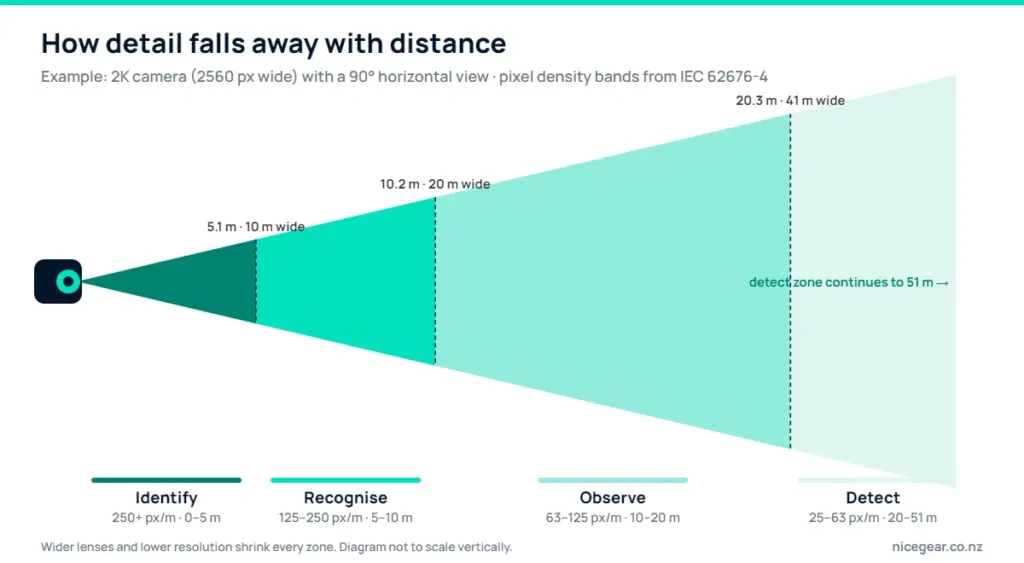
The calculator below works it out for any camera. Use the horizontal field of view from the spec sheet; many brands headline the wider diagonal figure.
Camera coverage and detail calculator
Enter a camera’s resolution and horizontal field of view to see how wide an area it covers at a given distance, and whether there is enough detail to recognise or identify someone.
Detail levels follow IEC 62676-4 (2014): detect 25 px/m, observe 63, recognise 125, identify 250. The bar fills at identification level. Use the horizontal field of view from the spec sheet, because many brands headline the wider diagonal figure (the Tapo C425 is 144° diagonal but 122° horizontal). Focus, compression, lighting and night mode all reduce real-world detail.
As a worked example, a 2K camera (2560 pixels wide) with a 100-degree lens mounted 8 metres from a gate covers a strip about 19 metres wide at 134 pixels per metre. That is enough to recognise a family member but not to identify a stranger, which needs the camera within about 4.3 metres or a narrower lens.
Night vision range
Infrared night vision typically reaches 10 to 30 metres; Tapo’s C320WS, for example, claims up to 30 metres. That is how far the camera can see a shape in black and white, not how far it can identify a face, which still follows the pixel-density rule above. Colour night vision comes from starlight sensors that make the most of streetlights and moonlight, or from a built-in spotlight that switches on when someone approaches.
Infrared bounces back off anything close to the lens. Eaves, gutters, spider webs and walls just inside the frame all cause glare, and a camera behind a window at night mostly records its own reflection.
Battery vs wired outdoor cameras
| Recording | 24/7 or motion | Motion clips | Motion clips |
|---|---|---|---|
| Upkeep | None | Recharge every few weeks to months | Little in summer, may need a winter top-up |
| Installation | Needs power or a cable run | Anywhere with Wi-Fi | Anywhere with Wi-Fi and direct sun |
| Example (NZ price from) | Tapo C320WS, $111 | Tapo C425, $172 | Tapo C610 KIT, $229 |
Wired is the better choice wherever a power point or cable run is practical: it records continuously, starts instantly and never goes flat. A battery camera wins where running a cable would mean lifting weatherboards or trenching, and for renters who can’t drill into the house. For outdoor CCTV, PoE cameras take one Ethernet cable for power and video; our guide to network switches covers PoE switches if you are adding several.
Battery life claims assume light use. Tapo quotes up to 300 days for the C425 based on 230 seconds of activity a day, which a driveway facing a busy street will blow through far sooner. Adding a panel helps, but a southern winter gives little sun to spare; our solar security camera guide has a calculator for NZ cities.
Wireless outdoor security cameras and Wi-Fi
A wireless outdoor security camera still needs a good 2.4 GHz Wi-Fi signal where it is mounted, and outside walls are where signal is weakest. Brick veneer, concrete and foil-backed insulation all cut it, and so does distance to a garage or shed. If the live view stutters at the mounting spot, fix the Wi-Fi first with a mesh node or an outdoor Wi-Fi extender, or choose a camera with an Ethernet port. Some eufy systems also connect cameras to a HomeBase rather than directly to the router.
Floodlight cameras
A floodlight camera combines bright LED lights with a camera, so it lights up the driveway, deters casual visitors and records in colour at night. Arlo’s Wired Floodlight ($289 in NZ) puts out 2,000 lumens with a 2K HDR camera and 160-degree view, and its Wireless Floodlight runs on battery for $299. Tapo’s C615F KIT (from about $289) pairs a pan/tilt camera and floodlight with a solar panel.
Wired floodlights connect to mains wiring, usually in place of an existing outdoor light. WorkSafe’s rules let owner-occupiers replace some fittings themselves, but if you are not confident, or the circuit needs changing, use an electrician.
Outdoor security cameras worth considering in NZ
| Model | Type | Resolution | Power | NZ price |
|---|---|---|---|---|
| Tapo C320WS | Fixed | 2K 4MP | Plug-in, Ethernet port | From about $111 |
| Tapo C520WS | Pan/tilt | 2K 4MP | Plug-in, Ethernet port | From about $113 |
| Tapo C425 | Fixed | 2K 4MP | Battery | From about $172 |
| Arlo Pro 6th Gen | Fixed | 2K HDR | Rechargeable battery | $229 (Arlo NZ) |
| eufy SoloCam S220 | Fixed | 2K | Battery with built-in solar | $299.95 RRP |
| eufy SoloCam S340 | Dual lens, pan/tilt | 3K wide plus 2K telephoto | Battery with solar panel | $499.95 RRP |
| Arlo Wired Floodlight | Floodlight | 2K HDR | Mains wired | $289 (Arlo NZ) |
| Tapo C660 KIT | Pan/tilt | 4K 8MP | Battery with solar panel | From about $240 |
For a gate or shed with no Wi-Fi at all, Arlo’s Go 2 ($489) can send footage over the mobile network instead. For more on each brand, see our guides to Tapo cameras, eufy’s no-subscription cameras and Arlo and its subscription.
Common mistakes with outdoor cameras
- Trusting the headline field of view. A 160-degree diagonal lens covers a lot but shows little detail at the letterbox. Check the horizontal figure and run the numbers.
- Mounting too high. At 4 metres or more you record hats and hoods, not faces.
- Pointing into the light. Sunrise, sunset and porch lights turn visitors into silhouettes.
- Forgetting the power adapter. Plug-in outdoor cameras come with indoor adapters; keep them inside or in a weatherproof box.
- Skipping a night test. Check the live view after dark before you finish, when glare from eaves and spider webs shows up.
Our take
- Front door and driveway with power nearby: a wired 2K camera such as the Tapo C320WS or C520WS, on Ethernet if the Wi-Fi is weak.
- No power point: a battery camera like the Tapo C425 or Arlo Pro 6th Gen, with a solar panel only where it gets real winter sun.
- Weatherproofing: insist on IP66, mount under the eaves and use stainless fixings near the coast.
- Placement: keep face-level cameras within about 5 metres of doors and gates, and use the calculator before you drill.
Prices were checked in September 2026 and change often; “from” prices are the lowest NZ retail listings we found, and RRPs are from brand stores. Nicegear is independent, sells nothing and has no commercial relationship with any brand or retailer mentioned.
Sources and further reading
- IP code ratings under IEC 60529 – Wikipedia
- Pixel density based on IEC 62676-4:2014 – Axis Communications white paper
- Tapo C320WS specifications – TP-Link Tapo
- Arlo cameras and floodlights – Arlo New Zealand
- Security cameras – eufy New Zealand
- CCTV at home – Office of the Privacy Commissioner
- Doing your own electrical work – WorkSafe NZ
- Mass surveillance in New Zealand – Wikipedia
FAQs
What is the difference between IP66 and IP67 for security cameras?
IP66 means a camera has been tested against powerful water jets, while IP67 means it survived immersion to 1 metre for 30 minutes. Water ratings are not cumulative beyond IPX6, so for rain on an outside wall IP66, or a dual IP66/IP67 rating, is the one to look for.
How high should an outdoor security camera be mounted?
About 2.5 to 3 metres suits most homes: high enough to be hard to reach, low enough to see faces. Angle it slightly down, facing the way people approach.
How far can outdoor security cameras see at night?
Infrared night vision usually reaches 10 to 30 metres, but that is how far it can see a shape. To identify a face you generally need to be within a few metres, depending on resolution and lens.
Are battery or wired outdoor cameras better?
Wired cameras are better wherever you can get power to them, because they record 24/7 and never need charging. Battery cameras suit renters and spots far from a power point, and a solar panel reduces recharging.
Do wireless outdoor security cameras work without Wi-Fi?
Most need Wi-Fi to send alerts and live video, though many keep recording to a card or hub if the connection drops. For sites with no Wi-Fi at all, 4G cameras such as the Arlo Go 2 use mobile data instead.
Do I need an electrician to install an outdoor camera in NZ?
Not for plug-in, battery, solar or PoE cameras. A wired floodlight or a new outdoor power point involves mains wiring, which WorkSafe’s rules limit to specific tasks for owner-occupiers, so most people use an electrician.


