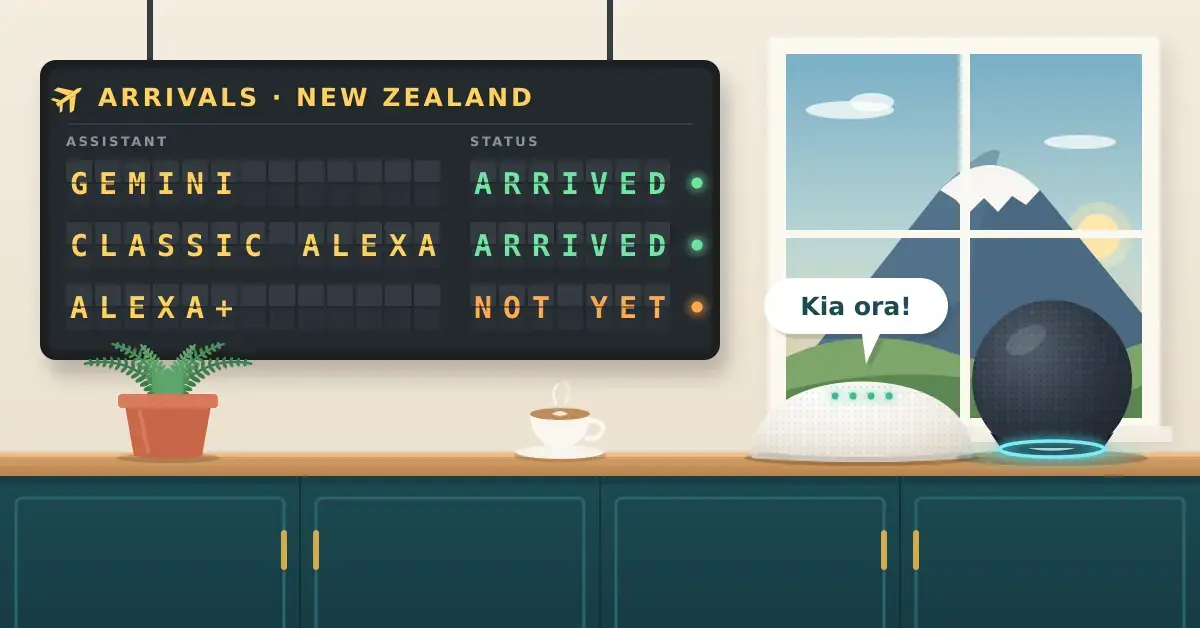
For most New Zealand homes, Google Home is the safer buy: it is officially sold and supported here, it handles Kiwi accents and local questions better, and its new Gemini assistant already runs on hardware you can walk into a shop and buy. Amazon Alexa is the pick if you want the cheapest multi-room setup or the deepest custom automations — but with one big catch in 2026: Amazon’s new AI assistant, Alexa+, has not launched in New Zealand yet, so Echo speakers sold here still run the older, classic Alexa. This guide compares the two on price, voice, music, smart-home control and privacy for the New Zealand market, so you can match the right one to your home.
Key points
- Google Home is the safer pick for most NZ homes: officially sold and supported here, best local voice recognition, and its new Gemini assistant already runs on hardware you can buy locally.
- Amazon Alexa offers the widest range of cheap speakers and the deepest routines, but Alexa+ (its new AI) hasn’t launched in New Zealand yet — Echoes sold here still run the classic Alexa.
- Prices are close: the Google Home Speaker and Echo Dot Max sit in the mid-range, while the Nest Mini and Echo Dot are the budget options.
- Matter reduces lock-in: most new bulbs, plugs and sensors work with either assistant, so your accessories move with you.
- Quick rule: pick Google if you live in the Android/Google world; pick Alexa for the cheapest multi-room setup and the most detailed automations.
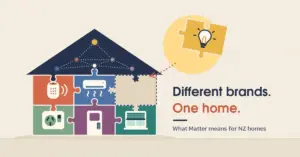
If you are starting from scratch and buying new bulbs, plugs and sensors anyway, the Matter smart-home standard means most accessories now work with either assistant — so the speaker you pick locks you in far less than it used to.
Google Home vs Amazon Alexa: the NZ comparison at a glance
The real differences come down to local availability, voice quality and how far each system’s new AI features have reached New Zealand. The table below lines up the current speakers you can actually buy here.
Comparison
| Speaker | Assistant (NZ) | Approx NZ price (incl GST) | Best for |
|---|---|---|---|
| Google Nest Mini (2nd gen) | Google Assistant / Gemini for Home | Budget end of the range | Cheapest Google entry; voice, timers, casual music |
| Google Home Speaker (2026) | Gemini for Home | NZ$219 | New Google flagship; Matter hub and Thread border router |
| Google Nest Hub (2nd gen) | Google Assistant / Gemini | Clearance; check stock | Smart display: photos, recipes, camera feeds |
| Amazon Echo Dot (5th gen) | Classic Alexa (no Alexa+ in NZ yet) | Budget end of the range | Cheapest Echo; compact, good sound for its size |
| Amazon Echo Dot Max (2025) | Classic Alexa in NZ (built for Alexa+) | Mid-range | Best-sounding small Echo; newer hardware |
| Amazon Echo Show 8 / 11 | Classic Alexa in NZ | Varies by retailer | Alexa smart displays and video calls |
Prices and stock change often; check PB Tech, Noel Leeming or the Google Store for the current figure before you buy.
The big 2026 change: both assistants went generative AI
Both Google and Amazon have replaced their old voice assistants with large-language-model (“generative AI”) versions that hold a conversation, remember context and handle follow-up questions. How far each has rolled out to New Zealand is the deciding factor for many buyers.
Gemini for Home (Google)
Google is replacing Google Assistant with Gemini for Home on its speakers and displays. The rollout began in supported regions from late 2025 and has widened since; the new conversational assistant understands natural, multi-part requests (“turn off the lounge lights and set an alarm for 6:30”) and lets you ask follow-up questions without repeating yourself. Basic Gemini for Home features are free, while the more advanced “Gemini Live” back-and-forth conversation sits behind a paid Google Home Premium subscription, which in New Zealand costs from about NZ$15 a month.
Crucially for New Zealand, Google’s hardware is sold here and the Gemini features are arriving on it, including on the new Google Home Speaker (below). You are buying into a platform that is actively supported in this market.
Alexa+ (Amazon) — and why NZ is still waiting
Amazon’s equivalent is Alexa+, a rebuilt generative-AI assistant that first appeared in the United States in early 2025. It has since reached more than ten countries, including Australia — where early access began in August 2026 — but not New Zealand. Where Alexa+ is live, it is free for Amazon Prime members and costs a monthly fee (about A$29.99 in Australia) for everyone else.
New Zealand is not on that list yet. Amazon has said it is working on localising Alexa+ for Australia and New Zealand, but as of late 2026 there is no NZ launch date. In practice that means an Echo you buy in New Zealand today runs the classic Alexa, not the new AI version. If the smart, conversational assistant is the reason you are considering Alexa, that reason does not fully apply here until Amazon flips the switch. This is the clearest case where a global “Alexa is smarter now” review does not describe the New Zealand reality.
Devices and prices in New Zealand
Entry prices are similar on both sides: a budget speaker costs roughly NZ$45–110, and a better-sounding speaker or smart display sits around NZ$200–350. The difference is availability and support, not just the sticker.
Google Nest and Home speakers in NZ
Google’s line-up is sold officially through PB Tech, Noel Leeming, JB Hi-Fi and other retailers:
- Google Nest Mini (2nd gen) — the cheapest Google entry point, sitting at the budget end of the range above. Good for voice, timers, questions and casual music.
- Google Home Speaker (2026) — Google’s first new standalone speaker in about six years. It launched in New Zealand in June 2026 for NZ$219, ships with Gemini for Home, has three far-field microphones and a physical microphone mute switch, and doubles as a Matter hub and Thread border router so it can control smart devices directly.
- Google Nest Hub (2nd gen) — a smart display for photos, recipes, video calls and viewing camera feeds. It is older and increasingly cleared from shelves, so check stock before relying on it.
Amazon Echo speakers in NZ
Echo devices are stocked by the same big retailers, but because there is no Amazon NZ store, some listings are parallel imports — double-check that you get a New Zealand (Type I) plug rather than a US or UK adapter:
- Echo Dot (5th gen) — the long-running budget Echo, sitting at the budget end of the range above. Compact, with decent sound for its size.
- Echo Dot Max (2025) — a larger, better-sounding small speaker built from the ground up for Alexa+, in the mid-range price band. It has the newer AZ3 processing chip, though in New Zealand it still runs classic Alexa for now.
- Echo Studio and Echo Show 8 / 11 — the premium speaker and the smart displays. These are available through retailers but stock and pricing vary more than Google’s, so compare before you buy.
Whichever side you choose, a smart plug is usually the cheapest first accessory for turning lamps, heaters or the jug into voice-controlled devices.
Which is better for lights and automation?
Alexa has a slight edge for smart lights, switches and complex automations. In our view, Echo speakers tend to react a fraction faster to “turn on the lights” commands, and Alexa Routines are more flexible — you can trigger a sequence of actions from a schedule, a sensor, a voice phrase or even a tap, and chain several together. That depth is why keen tinkerers often lean Amazon.
Google is not far behind and has closed much of the gap with its own Automations, which the Gemini assistant can now help you build in plain language. For a typical home — a few bulbs, a plug, a “goodnight” routine — both are more than capable. If you want automations that go well beyond voice, a dedicated hub such as Home Assistant Green sits above either assistant and keeps the logic running locally.
Which is better for music and sound quality?
For pure sound, Amazon has historically had the edge at the budget end, and its larger speakers like the Echo Studio aim at better bass and room-filling audio. The new Google Home Speaker narrows that gap at the mid-range with a larger driver than the old Nest Mini.
The bigger question is which music service you use. Both work with Spotify. Google ties in neatly with YouTube Music, while Alexa favours Amazon Music and Apple Music. Multi-room audio — the same song playing through several speakers — works on both, and Echo’s low device prices make a whole-house setup cheaper to assemble. If music is the main job, match the speaker to the service you already pay for rather than the brand.
Which is smarter for general questions and NZ voice?
Google generally wins for answering everyday questions and for understanding New Zealand accents, place names and local context, because it draws on Google Search and is tuned for this market. Ask about the weather in Taupō, the drive time to the bach, or a general knowledge question, and Google tends to answer more accurately.
Alexa is strong at tasks and “Skills” — third-party add-ons for anything from recipes to trivia — and at fast, reliable command handling. But because Alexa+ has not launched in New Zealand, its newest conversational smarts are not yet available here. On the classic Alexa that ships locally, Google is the better general-knowledge assistant for most Kiwi questions.
Smart displays and video calls
Both brands make smart displays — screens with the assistant built in — for the kitchen bench or bedside table. Google’s Nest Hub range shows Google Photos, recipes, calendars and live feeds from compatible cameras, and handles Google Meet and Duo-style calls. Amazon’s Echo Show range does the same with Alexa, Amazon Photos and video calling, and the newer models have larger, sharper screens.
A smart display is worth it if you want a visible timer while cooking, a digital photo frame that also answers questions, or a screen to glance at your home security cameras. If you only want voice and music, a plain speaker is cheaper and does the same listening.
Smart-home compatibility and Matter
You are far less locked in than you used to be, thanks to Matter. Matter is a shared smart-home standard backed by Google, Amazon, Apple and Samsung, so a Matter-certified bulb, plug or sensor works with Google Home and Alexa alike. The new Google Home Speaker and many Echo and Nest Hub models also act as hubs, so they can talk to low-power Thread and Zigbee devices directly.
What this means in practice: pick your speaker for voice, price and the phone you own, and buy Matter-certified accessories so you keep your options open. If you are weighing up what to buy first, our guide to smart home devices worth buying and our plain-English look at hubs, protocols and routines cover the accessories that work with either assistant.
Privacy and your data
Both assistants listen for a wake word (“Hey Google” or “Alexa”) and send what you say after it to the cloud to be processed, and both store a history you can review and delete. Neither is private in the way a device that works fully offline is.
Practical steps apply to both: use the physical microphone mute switch when you want the speaker deaf, turn off or auto-delete voice recordings in the app, and decline the option to have humans review your clips. If strict local-only control matters to you — nothing leaving the house — a self-hosted hub is a better fit than either cloud assistant.
Why are some people switching away from Alexa?
The main reasons are feature changes, subscription creep and NZ availability — not that the hardware stopped working. Amazon has retired or changed some features over the years (shared shopping-list integrations are a common gripe), and the move to Alexa+ pushes the best new features toward a paid tier or a Prime membership. In New Zealand specifically, the lack of an official Amazon store and the Alexa+ delay make Google the lower-friction choice for some households.
None of this makes an existing Echo useless. If you already own Echo speakers and like them, they keep doing timers, music, weather and smart-home control. The switching conversation is mostly about where the platform is heading and which company supports your market best.
Common mistakes NZ buyers make
- Assuming Alexa+ is available here. The glowing “Alexa is an AI now” reviews are mostly US, UK, Canada or Australia. In New Zealand you still get classic Alexa until Amazon launches locally.
- Ignoring the plug on parallel-import Echoes. Some NZ Echo listings ship with an overseas adapter or none at all. Confirm you get a Type I (AS/NZS) plug.
- Buying the wrong ecosystem for your phone. An iPhone works with both, but an Android household gets the smoothest experience from Google, and heavy Amazon shoppers get more from Alexa.
- Forgetting the running cost of “premium” AI. The best conversational features on both sides increasingly sit behind a subscription. Budget for the speaker and the ongoing fee if you want them.
Who should buy which
Match the system to how your home already works:
- Buy Google Home if you use an Android phone or Google services, want the best New Zealand voice recognition and general answers, prefer buying from a local shop with local support, and want the newest AI features already working here.
- Buy Amazon Alexa if you want the cheapest way to cover several rooms, you love building detailed routines, you shop heavily on Amazon, and you are comfortable that the newest Alexa+ smarts will arrive in New Zealand later rather than now.
- Either works if you mostly want timers, music, weather and simple voice control of a few lights — in which case buy on price and the phone in your pocket, and choose Matter-certified accessories so you can change your mind later.
If you would rather keep control of your smart home entirely in-house instead of relying on a cloud assistant, a local hub is the next step up from either speaker.
Sources
- Google — the new Google Home Speaker for New Zealand (Gemini for Home, NZ$219)
- Google — Gemini for Home announcement (The Keyword blog)
- Droid Life — new Google Home Speaker launch and specs (June 2026)
- Thurrott — Google Home Speaker launch date and price
- MacRumors — Gemini for Home rollout and Google Home Premium
- Amazon — new generative-AI Alexa (Alexa+) overview
- Amazon — new Echo devices purpose-built for Alexa+ (Echo Dot Max)
- Amazon — Alexa+ international launch markets
- TechRadar — Alexa+ early access arrives in Australia (Aug 2026)
- eCommerceNews NZ — Amazon localising Alexa+ for Australia and New Zealand
- EFTM — Alexa+ country rollout and pricing
Frequently asked questions
Is Alexa available in New Zealand?
Yes — Amazon Echo speakers are sold through New Zealand retailers and the classic Alexa assistant works here for music, timers, weather and smart-home control. What is not available in New Zealand yet is Alexa+, Amazon’s newer generative-AI assistant, which so far has reached more than ten countries, including Australia, but not New Zealand. There is no Amazon NZ store, so some Echo devices are parallel imports.
What can Alexa do that Google can’t?
Alexa’s main advantages are its larger range of affordable speakers, its deeper and more flexible Routines, and its wide library of third-party “Skills.” It also tends to respond a fraction faster to simple smart-home commands. Google counters with better general-knowledge answers, stronger NZ voice recognition and tighter links to Android and Google services.
Can Google and Amazon speakers control the same smart devices?
Mostly yes, because of Matter — a shared standard that lets a certified bulb, plug or sensor work with both Google Home and Alexa. Buying Matter-certified accessories means you are not locked to one assistant and can switch or mix speakers later without replacing your devices.
Do I have to pay a monthly fee to use a smart speaker?
No. The core features — voice control, music, timers, weather and basic smart-home commands — are free on both. The optional subscriptions (Google Home Premium, or Alexa+ where it is available) unlock the most advanced conversational AI and some camera features. You can run a useful smart speaker without ever paying a monthly fee.