

Starlink NZ plans cost $85 a month for Residential 100 Mbps, $125 for Residential 200 Mbps and $170 for Residential Max, with Roam from $100 and business plans from $92 (prices checked on starlink.com/nz in September 2026). Hardware ranges from nothing upfront in select areas to about $600 at retail.
This guide is for rural households, bach owners, travellers and small businesses who want the real numbers before signing up: monthly fees, hardware, installation, power and the extras nobody mentions. If you are still weighing up whether satellite suits your place at all, start with our Starlink NZ overview, then come back here to cost it.
Key takeaways
- All three residential plans include unlimited data. What you pay for is the speed cap and network priority, not a data allowance.
- Commerce Commission testing in April 2026 averaged 245 Mbps on Residential Max and 130 Mbps on Residential 100 Mbps, with 25–26 ms latency.
- Hardware costs anywhere from $0 upfront (select areas) to about $599 for a Standard Kit at retail. The Starlink Mini sells for roughly $349–$449.
- Budget for a mount or installer ($140–$290) and for power: the Standard dish averages 75–100 W, roughly $230–$310 a year at 35c/kWh.
- Most homes of one to three people will be fine on Residential 100 Mbps. Busy households, gamers and people working from home get the most from Max.
In this guide
- Starlink NZ plans and prices at a glance
- How much is Starlink in NZ upfront?
- Starlink NZ monthly cost: which plan should you pick?
- Starlink cost calculator: first-year and three-year totals
- Starlink Roam NZ price: travel, boats and the bach
- Starlink business plan NZ pricing
- Is there a Starlink NZ rural offer?
- What to check before you buy
- Starlink vs fibre and fixed wireless on price
Starlink NZ plans and prices at a glance
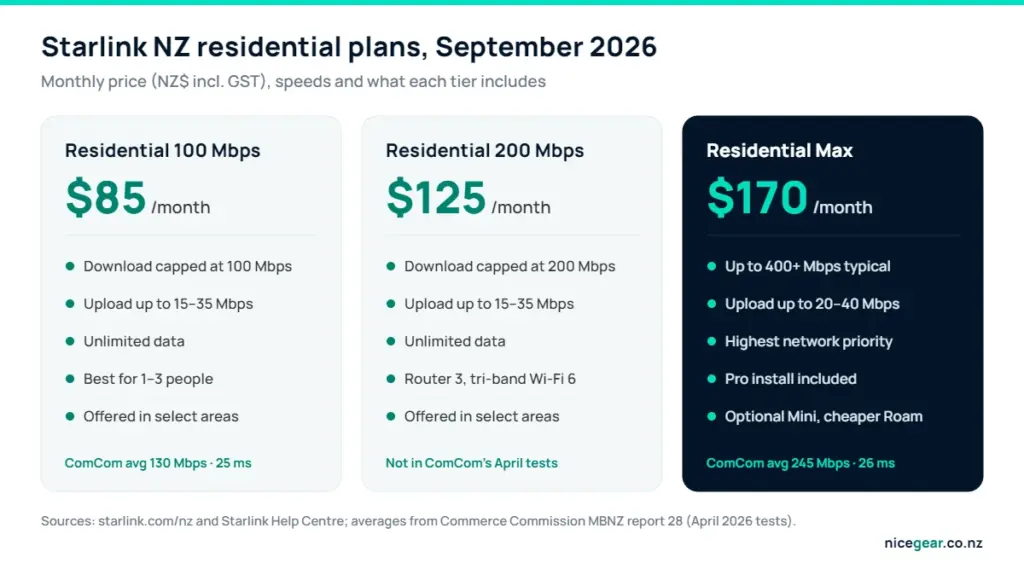
Starlink sells its plans direct in New Zealand (retailers sell the hardware), and it restructured its residential line-up in 2026. The old Residential and Residential Lite plans gave way to three speed tiers, and prices were adjusted again mid-year. This is what the NZ site listed when we checked in September 2026:
| Plan | Monthly price | Download speed | Data | Suits |
|---|---|---|---|---|
| Residential 100 Mbps | $85 | Capped at 100 Mbps | Unlimited | 1–3 people: browsing, streaming, calls |
| Residential 200 Mbps | $125 | Capped at 200 Mbps | Unlimited | Small to medium households |
| Residential Max | $170 | Up to 400+ Mbps typical | Unlimited, highest priority | Big households, gaming, working from home |
| Roam 100GB | $100 | Varies with location | 100 GB, then unlimited low-speed | Occasional trips, the bach |
| Roam Unlimited | $235 | Varies with location | Unlimited | Full-time travellers, campervans |
| Business (Local Priority) | from $92 | Priority speeds | 50 GB priority data and up | Farms, shops, offices |
The 100 Mbps and 200 Mbps tiers are marked “available in select areas”, so what you see at checkout depends on your address and how busy your local cell is. If a plan does not appear when you enter your address, it is not on offer there.
Starlink NZ price changes in 2026
Two things moved this year. First, Starlink swapped its two-plan residential structure for the 100 Mbps, 200 Mbps and Max tiers, a change the Commerce Commission’s broadband testing picked up in early 2026. Second, prices rose mid-year: NZ reports put the main residential plan’s increase at about 7%, from $159 to $170 a month, and the Standby (pause) fee also went up.
If you signed up before the change, check which plan your account now shows. The cheapest option for your household may be a different tier from the one you started on.
How much is Starlink in NZ upfront?
The monthly fee is only half the picture. Here is what the first bill can include.
Starlink hardware cost in NZ
The current Standard Kit (Starlink calls it Standard 4 X) comes with the dish, a kickstand, the Router 3 (tri-band Wi-Fi 6), a 15 m Starlink cable and the power supply. What you pay depends on where you buy and where you live:
- $0 upfront: Starlink advertises “no upfront hardware cost in select areas”. The offer appears, or doesn’t, when you enter your address on starlink.com. Read the checkout terms before you commit, because free-hardware deals usually come with conditions.
- About $449: the hardware price Starlink quotes on its NZ business page.
- About $599: JB Hi-Fi’s price for the Standard Kit in September 2026. Buying from a local retailer means a local store handles any Consumer Guarantees Act claim.
- Starlink Mini, $349–$449: JB Hi-Fi listed it at $349 and Noel Leeming at $449. It is the portable option, and our Starlink Mini NZ guide covers when it beats the Standard dish.
Buying second-hand? Make sure the seller has removed the kit from their Starlink account first, or you will not be able to activate it.
Installation and mounting costs
The kickstand is fine for testing on the lawn, but most permanent installs need a mount, and plenty of rural houses need a longer cable too. Typical NZ retail prices in September 2026:
| Item | Typical price | Notes |
|---|---|---|
| Kickstand (in the box) | $0 | Fine on a clear lawn or deck, not wind-proof |
| Third-party wall, pivot or pipe mount | $140–$190 | Laser ChargeCore range at Noel Leeming |
| Replacement Starlink cable, 45 m | $260 | For dishes well away from the house |
| Masonry routing kit | about $98 | Tidy cable entry through brick or block |
| Retailer setup and delivery | $189 | Noel Leeming Tech Solutions standard setup |
| Retailer wall-mount installation | $289 | Setup including wall mounting |
| Residential Max installation | Included | Starlink lists Home Pro Install with Max in NZ |
Our Starlink accessories guide explains which cables, routers and adapters you actually need, so you don’t pay for extras your kit already includes.
Starlink NZ monthly cost: which plan should you pick?
Every residential plan has unlimited data, so the real question is how much speed you need at the busiest time of the evening. Here is what each tier delivers in practice.
Residential 100 Mbps ($85 a month)
Downloads are capped at 100 Mbps with uploads of up to 15–35 Mbps, and Starlink pitches it at one-to-three-person households. In the Commerce Commission’s April 2026 testing, volunteers on this plan averaged 130 Mbps down and 47 Mbps up across all hours (115 Mbps at peak), with 25 ms latency. That comfortably covers a couple streaming 4K, video calling and browsing at the same time. The Commission also noted a big drop compared with the old Residential Lite plan, so don’t expect Max-like evenings.
Residential 200 Mbps ($125 a month)
Double the cap, the same upload range, and the Router 3 is included. It suits a family of four where two people might be streaming while someone else is on a video call or downloading a game. It was not part of the Commission’s April 2026 tests, so there is no independent NZ average for it yet.
Residential Max ($170 a month)
Max gets the highest network priority, which matters most at 8pm when your local cell is at its busiest. Starlink quotes typical downloads of up to 400+ Mbps and uploads of 20–40 Mbps; the Commission’s testing averaged 245 Mbps down (224 Mbps at peak), about 50 Mbps up and 26 ms latency. In New Zealand it also includes Home Pro Install and eligibility for an optional Starlink Mini with discounted Roam plans, which takes some of the sting out of the price.
Once you are connected, run our NZ broadband speed test at a few different times of day to see whether you are on the right tier. If speeds are fine next to the router but poor in the lounge, the fix is usually Wi-Fi coverage rather than a pricier plan, and our Starlink Wi-Fi extender guide covers the mesh options.
Starlink cost calculator: first-year and three-year totals
Choose a plan, how you will get the hardware, how you will install it and how many months a year you will use it. The calculator shows the upfront hit, the first-year total and what it really costs per month once the hardware is spread over three years.
Starlink NZ cost calculator
Pick a plan, how you’ll get the hardware and how many months a year you’ll use it. See the upfront hit, the first-year total and the real monthly cost over three years.
List prices from starlink.com/nz and NZ retailers, checked September 2026 (NZ$ incl. GST). Standby is estimated at $20 a month from NZ customer reports; confirm the current fee in your Starlink account. Mount and install figures are typical retail prices, not quotes. Power is extra: about $230–$310 a year for the Standard dish at 35c/kWh.
What 12 months of each Starlink plan costs in NZ
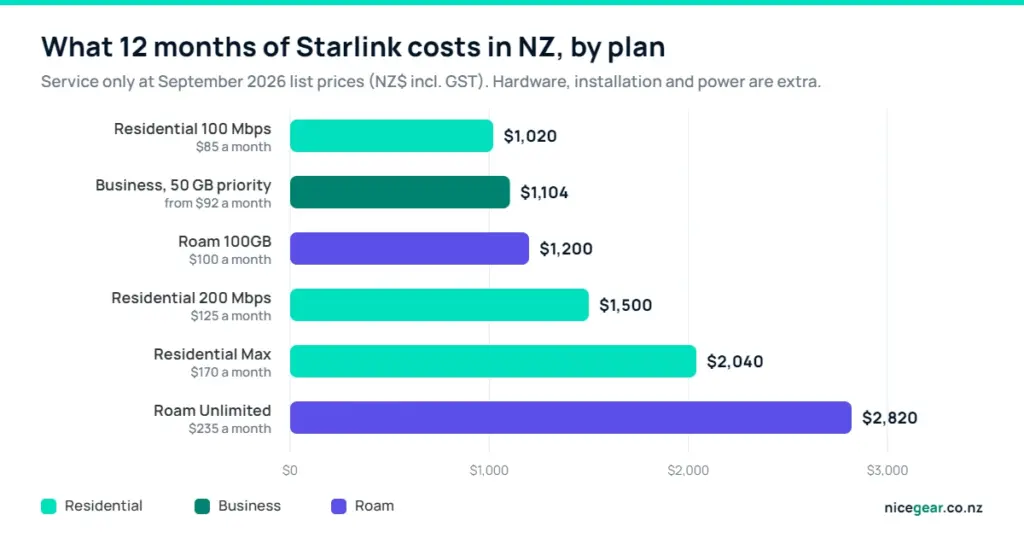
Before hardware, a year of Residential 100 Mbps costs $1,020 and a year of Residential Max $2,040. Roam Unlimited is the most expensive way to stay connected at $2,820 a year, which is why most people only use it while they are actually travelling.
Worked example: a bach used half the year
Say you want Starlink at a Coromandel bach you use from October to March. On Residential 100 Mbps, six active months cost 6 × $85 = $510. Pause over winter with Standby instead of cancelling and add roughly 6 × $20 = $120, for about $630 a year in service. Buy the Standard Kit at $599 plus a $165 mount and the first year comes to about $1,394. Over three years it averages around $74 a month.
Standby keeps a slow connection alive for emergency messages and lets you reactivate without re-ordering. Starlink says it is available on Residential, Roam and Priority plans, excluding promotional offers and some kit rentals.
The running cost nobody quotes: power
Starlink’s spec sheet puts the Standard dish’s average draw at 75–100 W. Left on around the clock, that is about 657–876 kWh a year, or roughly $230–$310 at an average residential rate of about 35c/kWh. The Mini averages 25–40 W, which works out at roughly $77–$123 a year. A timer can trim this if nobody needs the internet overnight, but the dish needs a few minutes to boot and reconnect each time the power comes back.
Starlink Roam NZ price: travel, boats and the bach
Roam plans let you use Starlink anywhere it has coverage, not just at your registered address:
- Roam 100GB, $100 a month: 100 GB of full-speed data, then unlimited low-speed data for the rest of the month.
- Roam Unlimited, $235 a month: for people living on the road or working from a campervan.
Roam covers territorial and inland waters, with open-ocean coverage as an option, and you can pause it with Standby between trips. Pair it with the Mini and you have a kit that runs from a 12 V system in a campervan or boat. Our guide to the Starlink Mini in NZ works through power and mounting.
Starlink business plan NZ pricing
Business plans start at $92 a month with a hardware cost of $449, according to Starlink’s NZ business page. They are built around priority data rather than speed tiers: you choose a preset allowance and add blocks of 50 GB or 500 GB as needed. Priority traffic gets precedence on the network, so EFTPOS, cloud accounting and video calls hold up better when the local cell is busy. NZ resellers list bigger allowances at several hundred dollars a month (500 GB at roughly $260), so get a quote before running a farm office or shop on it.
Is there a Starlink NZ rural offer?
Not in the form of a government subsidy or a rural-only plan. The closest thing is Starlink’s own “no upfront hardware cost in select areas” deal, which shows up for some addresses depending on local capacity. Starlink does not publish a list of qualifying areas, so the only way to check is to enter your address at starlink.com/nz.
Starlink is now the biggest name in rural broadband: the Commerce Commission reported in June 2026 that it holds 27% of rural connections, more than any other provider. It is not the only option, though. Of people moving off copper, the Commission found 54% chose Starlink and 46% stayed with local providers, so compare it with regional fixed-wireless operators first. Our Wireless Nation review is a good place to start.
What to check before you buy
The common mistakes cost more than the gap between plans:
- Paying for Max when 100 Mbps would do. Try a cheaper tier for a month and test it. You can change plans in your account, subject to availability.
- Ignoring obstructions. Trees and roof lines cause short dropouts. Run the obstruction check in the Starlink app before you drill any holes.
- Forgetting the extras. A mount plus a retailer’s install service adds roughly $330–$480 to the first bill, and a 45 m cable another $260.
- Assuming the router covers the whole house. The Router 3 is rated for up to 297 m² in ideal conditions; brick, concrete and foil-backed insulation shrink that quickly.
- Buying used without a transfer. Get the seller to remove the kit from their account before you hand over any money.
- Forgetting power cuts. Starlink goes down when the power does. Our Starlink outage guide covers backup options.
Starlink vs fibre and fixed wireless on price
If fibre reaches your gate, it will almost always win. The Commission’s April 2026 averages had Fibre Max at 877 Mbps with 5 ms latency, against 245 Mbps and 26 ms for Starlink Max. Where fibre is not an option, the Commission reports Starlink’s peak-time downloads are around four times faster than 4G fixed wireless, the next best alternative. On value, Residential 100 Mbps at $85 for a tested 130 Mbps average is about 65c per Mbps a month; Max at $170 for 245 Mbps works out at about 69c.
Our take
- Most rural households of one to three people: start on Residential 100 Mbps at $85. It tested above its cap in April 2026, and you can step up later.
- Busy families, gamers and people working from home: Residential Max at $170 is the one to have. The priority, included install and optional Mini make up some of the difference.
- Baches and holiday homes: pay for the months you use and pause the rest with Standby.
- Travellers: Roam 100GB with a Mini is the cheapest way to carry reliable internet. Move to Unlimited only if you live on the road.
Starlink changes plans, prices and offers often and with little notice. Prices are NZ$ including GST, checked on starlink.com/nz and NZ retailer sites in September 2026. Nicegear is independent, sells nothing and has no commercial relationship with Starlink or any retailer mentioned.
Sources and further reading
- Starlink Residential plans – starlink.com/nz
- Starlink Roam – starlink.com/nz
- Starlink for Business – starlink.com/nz
- What are the Residential plans? – Starlink Help Centre
- How does pausing service work? – Starlink Help Centre
- Standard kit specifications – Starlink (PDF)
- Measuring Broadband New Zealand report 28, July 2026 – Commerce Commission (PDF)
- Rural connectivity: a market reset in motion – Commerce Commission
- Starlink – Wikipedia
FAQs
How much is Starlink in NZ per month?
Residential plans cost $85 (100 Mbps), $125 (200 Mbps) or $170 (Max) a month, Roam costs $100 or $235, and business plans start at $92. These are list prices on starlink.com/nz in September 2026, including GST.
Does Starlink NZ have a data cap?
No residential plan has a data cap: 100 Mbps, 200 Mbps and Max all include unlimited data. Roam 100GB gives you 100 GB at full speed and then unlimited low-speed data, while business plans are sold in blocks of priority data.
How much does Starlink hardware cost in NZ?
It ranges from $0 upfront in select areas to about $599 for the Standard Kit at retail, and Starlink quotes $449 for business hardware. The Starlink Mini was $349–$449 at NZ retailers in September 2026.
What is the cheapest Starlink plan in NZ?
Residential 100 Mbps at $85 a month is the cheapest ongoing plan, if it is offered at your address. For part-time use, a residential plan paused with Standby between visits can work out cheaper across a year.
How much is Starlink Roam in NZ?
Roam 100GB costs $100 a month and Roam Unlimited $235 a month. Both can be paused with Standby mode, and Residential Max customers can add a Mini with discounted Roam pricing.
Can I pause Starlink over winter?
Yes. Standby mode pauses full service for a small monthly fee (around $20 according to NZ reports from mid-2026) and keeps low-speed data for emergency messaging. You switch it on and off from your account on starlink.com.
Is Starlink worth it compared with fibre?
Not if you can get fibre, which is faster, has far lower latency and is usually better value per Mbps. Starlink earns its keep where the alternatives are copper, patchy 4G or slow fixed wireless.


