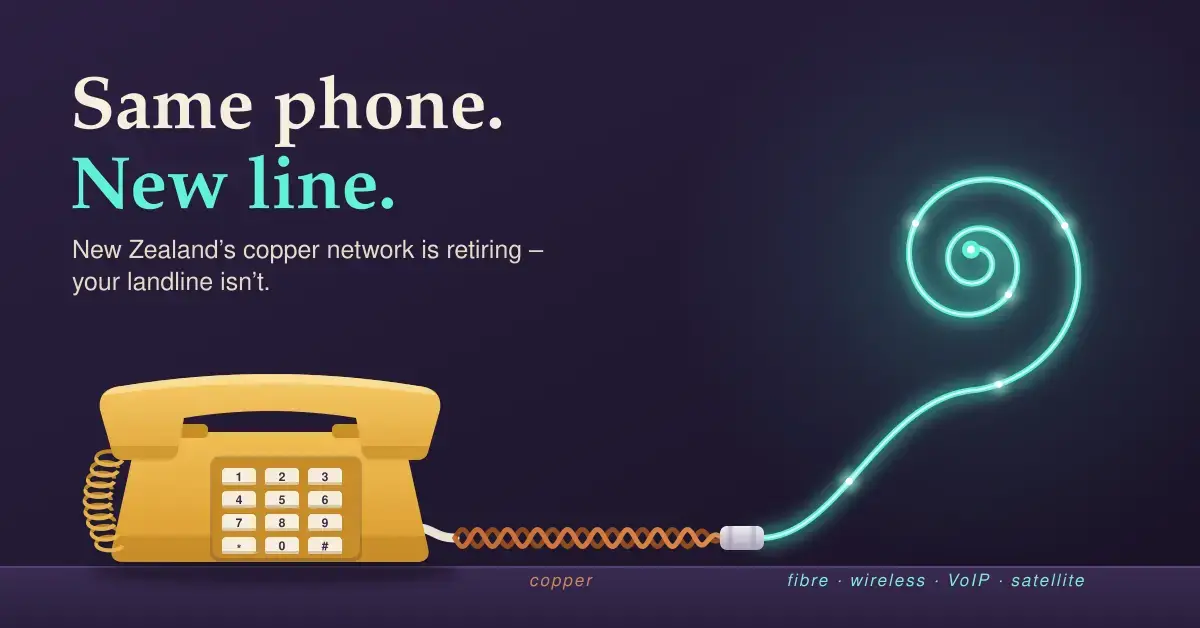
If you have had a letter saying your copper phone line is being withdrawn — or your old landline has simply stopped working — you are not alone. New Zealand is retiring the copper network that carried home phones for more than a century, and hundreds of thousands of households have already been moved onto something newer. The good news is that a landline is not disappearing; only the wire under the street is. This guide explains, in plain English, why it is happening, when it affects you, and every genuine landline alternative you can switch to in 2026 — including how to keep your existing number and still reach 111 in an emergency.
Key Points
- Copper is going, not the landline. New Zealand’s copper phone network is being retired nationwide by 2028 (end of 2026 in fibre areas); your home phone moves to fibre, wireless, VoIP or satellite.
- You get at least six months’ notice before copper is withdrawn at your address, with a final reminder at least 30 days out.
- You keep your number. Existing landline numbers can be ported to the new service — let the new provider move it for you.
- Five real options: home phone over fibre, wireless home phone over the mobile network, mobile only, independent VoIP, or satellite for remote properties.
- Plan for power cuts. Unlike copper, the new options stop working when your power goes out unless you have a battery backup or a charged mobile.
- Sort your medical alarm first and register as a vulnerable consumer if anyone relies on the phone to call 111 — the backup is free.
Why your copper landline is being cut off
Your copper landline is being cut off because the national copper network is being decommissioned and replaced with fibre. Chorus, the company that owns most of the copper and fibre lines that run to New Zealand homes, has been withdrawing copper since 2021 in areas where fibre is already available. In April 2026 it accelerated the programme and now aims to retire copper across the whole country by 2028 — roughly two years earlier than its previous timetable — with copper in fibre-served towns and suburbs gone by the end of 2026.
At the same time, Spark is retiring its old PSTN (the Public Switched Telephone Network — the exchange equipment that actually carried copper phone calls). Spark is switching this off suburb by suburb and moving customers to a home phone that runs over fibre or over the mobile network instead. The two changes often land on the same household at once: the broadband and the phone both move off copper together. If this is new to you, it helps to understand how New Zealand’s phone and internet networks are structured and who actually owns the lines.
The reason is simple economics and performance. Copper is slow, expensive to maintain and increasingly unreliable, while fibre is faster, cheaper to run and far more robust. Keeping two national networks running in parallel no longer makes sense, so copper is being retired wherever fibre has arrived.
When is the landline being switched off in New Zealand?
There is no single nationwide switch-off date — the copper retirement is happening address by address, on a rolling schedule, between now and 2028. What matters is the notice you receive for your own property, not a national deadline.
Under the Commerce Commission’s Copper Withdrawal Code, your provider must give you plenty of warning before anything stops working:
- First notice: at least six months before copper is withdrawn at your address.
- Follow-up notices: further reminders during that period so the deadline does not catch you out.
- Final reminder: at least 30 days before the withdrawal date.
Two protections are built in. First, copper can only be withdrawn where a suitable alternative — almost always fibre — is available at your property. Second, if fibre has not reached you (common on rural and remote properties), you are not simply cut off; your provider works through a transition plan with you to a wireless or satellite alternative. If you have not been contacted, you do not need to do anything yet. If you have, you need to choose a new service before your current one ends.
Will you lose your phone number?
No — in almost every case you can keep your existing landline number when you switch. Your number is not tied to the copper wire; it can be “ported” (transferred) to a new provider or a new type of service. The phone simply connects through a modem, a small adapter or the mobile network instead of the wall jack in the hallway.
A port usually takes about five to seven business days with most providers, and you keep using your old service until the new one goes live, so you are rarely without a phone. The one thing to avoid is cancelling your old line before the number has transferred — once a number is disconnected it can be much harder to recover, so always let the new provider pull it across for you.
What are your landline alternatives in NZ?
There are five realistic landline alternatives in New Zealand, and the right one depends on whether you have fibre, how much you use the phone, and whether you want a traditional handset on the kitchen bench. Here is each option explained.
A home phone over fibre
A home phone over fibre is the closest replacement for a traditional landline and the option most people are moved to. Your phone plugs into a port on the back of your fibre modem (an ONT and router), and calls travel over your internet connection using the same technology as VoIP. You keep a normal handset, keep your number, and in most cases the sound quality is clearer than copper ever was.
Every major retailer — Spark, One NZ, 2degrees and the smaller broadband companies — offers a home phone add-on to a fibre plan, typically for a small monthly fee on top of your broadband. It is the simplest choice if you already have, or are getting, fibre. The only real catch is that it needs mains power at your house to work, which matters in a power cut (covered below).
A wireless home phone (landline over the mobile network)
A wireless home phone keeps a desk handset but connects over the 4G or 5G mobile network instead of a cable, which makes it ideal where fibre has not arrived. Spark’s Home Wireless Landline, for example, supplies a small modem and cordless handsets and delivers a landline-style service over its mobile network, with your existing number ported across. One NZ and 2degrees offer similar wireless home-phone or fixed-wireless voice options.
This suits rural and lifestyle properties, renters who do not want to arrange a fibre install, and anyone who wants to keep a “proper” home phone without a fibre connection. It depends on having decent mobile coverage at the address, and, like fibre, the modem needs power to work.
Just use a mobile phone
Dropping the landline entirely and using a mobile is the cheapest and most resilient option for many households. A mobile has its own battery, so it keeps working in a power cut as long as there is coverage and charge — something no fixed-line option can match. Prepaid and low-cost plans start from around $10–$20 a month, and you can port your old landline number onto a mobile if you want to keep it.
The trade-offs are coverage (weak signal indoors or in rural areas is the usual complaint) and comfort — some people, especially older relatives, simply prefer a handset that sits in one place. A middle ground is a mobile plus a cordless “mobile home phone” dock that lets you use a normal handset with a SIM inside it.
An independent VoIP service
An independent VoIP (Voice over Internet Protocol) service lets you run a home or business phone number over any internet connection, usually for far less than a retailer’s bundled line. New Zealand providers such as 2talk and Kiwi VoIP offer plans from only a few dollars a month: Kiwi VoIP advertises a basic line from around $2.50 a month and a Home Basic plan near $10 a month (plus GST) with a bundle of local minutes, while 2talk runs tiers from a free account up to larger plans, all with no fixed contract.
You connect either a dedicated VoIP handset, a softphone app on your phone or computer, or an ATA (a small “analogue telephone adapter” that lets you keep your existing corded phone). Our guides to choosing a VoIP phone or adapter and the best VoIP providers in New Zealand walk through the setup. VoIP is the best value if you are comfortable with a little technology and already pay for broadband. If you only ever make the occasional call, an app-based option such as Google Voice or a calling app can cover you for free or near-free.
Satellite for rural and remote properties
Satellite internet is the fallback where neither fibre nor reliable mobile coverage reaches, and it can carry a phone service on top. A connection such as Starlink satellite internet gives a remote property fast broadband, and you then add calling through a VoIP service or simply use a mobile over the same connection with Wi-Fi calling. Rural fixed-wireless specialists like Wireless Nation offer similar rural broadband with voice add-ons. These options carry a higher monthly cost, but for an isolated farm or bach they are often the only way to keep both internet and a phone.
Comparison
| Option | How it connects | Needs home internet? | Works in a power cut? | Typical monthly cost | Best for |
|---|---|---|---|---|---|
| Home phone over fibre | Plugs into the fibre modem | Yes (fibre) | No — only with battery backup | Small add-on to a fibre plan | Homes that already have fibre |
| Wireless home phone | 4G/5G mobile network | No — standalone | No — modem needs power | Similar to a basic broadband plan | No fibre; want a desk handset |
| Mobile only | Mobile network | No | Yes — own battery + coverage | About $10–$20 | Cheapest, most power-cut resilient |
| Independent VoIP | Any internet connection | Yes | No — only with battery backup | From about $2.50–$15 (+GST) | Best value if you have broadband |
| Satellite + calling | Satellite dish + VoIP/mobile | Yes (satellite) | No — only with battery backup | From about $85 + calling | Rural and remote properties |
How much do landline alternatives cost?
The cheapest landline alternative in New Zealand is an independent VoIP line, starting from a few dollars a month, while a retailer’s bundled home phone and a wireless landline cost more but need no technical setup. Here is how the typical 2026 monthly costs stack up:
- Independent VoIP line: from roughly $2.50–$15 a month (plus GST), on top of broadband you already pay for.
- Home phone over fibre (retailer add-on): usually a modest add-on fee on top of a fibre broadband plan, which varies by retailer and plan.
- Wireless home phone (landline over mobile): a standalone monthly plan, generally in the same range as a basic broadband plan; useful where you do not want fibre at all.
- Mobile only: from about $10–$20 a month on a low-cost or prepaid plan, with no line rental at all.
- Satellite plus calling: satellite broadband from around $85 a month, plus a small VoIP or mobile cost for the phone itself.
Two one-off costs are worth knowing about: porting your number across is usually a small fee (around $20 with independent VoIP providers, often free when you move to a retailer’s own plan), and you may need a new handset or an adapter if your old phone cannot plug into the new service.
Will 111 and emergency calls still work?
Yes, you can still call 111 on every modern landline alternative — but there is one crucial difference from copper that everyone needs to understand: the new options stop working in a power cut unless you have a backup. An old copper phone drew its power from the telephone exchange or roadside cabinet, so it kept working even when your house lost power. Fibre, fixed wireless and VoIP all rely on mains power at your home to run the modem, so if the power goes out, the phone goes with it unless the equipment has a battery.
This is exactly why the Commerce Commission introduced the 111 Contact Code. The Code protects what it calls “vulnerable consumers” — people on a home landline who are at particular risk of needing the 111 emergency service and who do not have another way to call 111 that works for at least eight hours during a power failure. If that describes you or someone in your household, your provider must supply a backup solution (such as a battery unit or an alternative device) free of charge, and it cannot refuse or cut off your landline because you are, or might become, vulnerable.
For everyone else, the practical answer is to keep a charged mobile phone as your emergency backup, because a mobile has its own battery and does not depend on your home’s power. If you want your fixed line itself to survive an outage, a small UPS (uninterruptible power supply) or battery backup on the modem will keep it running for a while. If you believe you qualify as a vulnerable consumer, register with your provider — it is free, and it is the single most important step to take before copper is switched off.
What happens to your medical alarm, security alarm and EFTPOS?
Any device that relied on the copper phone line needs checking before the switch, because some will not work over fibre or wireless without changes. The most important is a monitored medical alarm: many older units dial out over the copper line, and they may not connect reliably through a fibre or VoIP service, especially in a power cut.
The safe process is straightforward:
- Medical alarms: call the company that monitors the alarm and ask whether it works over your new connection. St John’s medical alarm team (0800 502 424) can advise on compatible units, including wireless/mobile alarms that keep working if your internet or power drops.
- Monitored security and fire alarms: contact your alarm company before the copper goes; many now use a mobile (cellular) module or an internet connection instead of the phone line.
- EFTPOS terminals, fax machines and lift/intercom phones: check with the supplier, as older units may dial over copper and need updating or replacing.
- Cordless phones: a cordless handset needs mains power for its base station, so it will not work in a power cut even on copper — keep one corded or mobile phone as backup.
Always test the device after your service has been transferred, and never finalise a switch for a household that depends on a medical alarm until the alarm provider has confirmed the new connection works.
How to switch without losing service
Switching is low-risk if you do it in the right order. Follow these steps:
- Read the notice and note the deadline. Your letter or email states when copper will be withdrawn at your address — you have at least six months from the first notice.
- Check what is available. Confirm whether fibre has reached your property; if not, look at wireless home phone, mobile or satellite instead.
- Choose your option. Match it to how you use the phone: fibre home phone for simplicity, VoIP for value, mobile for cost and power-cut resilience, wireless or satellite for rural.
- Ask the new provider to port your number. Let them pull the number across rather than cancelling the old line yourself.
- Sort out alarms and emergency backup first. Confirm medical and security alarms are compatible, and register as a vulnerable consumer if that applies.
- Test everything. Once connected, make a test call (including to a mobile), check your number shows correctly, and confirm the alarm reports in.
Common mistakes to avoid
The most common and costly mistake is cancelling the old copper line before the number has ported, which can lose a number you have had for decades. A few others trip people up:
- Assuming the new phone works in a power cut. It does not, unless you have a battery backup or a charged mobile — plan for outages in advance.
- Forgetting the medical alarm. This is the single most dangerous oversight; sort the alarm before the phone switch, not after.
- Ignoring the notices. Leaving it until the final 30-day reminder leaves little time to arrange a fibre install or a new device.
- Not registering as a vulnerable consumer. The free 111 backup only reaches people who register with their provider.
- Paying for a bundled line you do not need. If you already have broadband, a cheap independent VoIP line or a mobile can be a fraction of a retailer’s add-on.
This guide is general information to help New Zealand households plan the switch from copper, not a substitute for advice from your own telecommunications or medical-alarm provider. If anyone in your home relies on a home phone to call 111, confirm your emergency-calling arrangements directly with your provider before your copper service ends.
Sources
- Chorus — Copper retirement
- Telecommunications Forum (TCF) — Copper retirement and landline changes
- Commerce Commission — 111 Contact Code
- Commerce Commission — Copper transition factsheet
- Spark — Retiring the copper (PSTN) network
- One NZ — Medical alarms and broadband
- St John — Medical alarms and Ultra-Fast Broadband
- 2talk — Voice pricing
- Kiwi VoIP — Home phone plans
Frequently Asked Questions (FAQ)
Is the landline being discontinued in New Zealand?
The copper landline is being discontinued, but the landline itself is not. The physical copper network is being retired nationwide by 2028 (sooner in areas that already have fibre), and your home phone is moving onto fibre, the mobile network, VoIP or satellite instead. You can keep a home phone and a landline-style number — only the old copper wire is going away.
Can I keep my old landline phone number?
Yes. Your number can be ported to a new provider or a new type of service, including fibre home phone, a wireless home phone or an independent VoIP line, and you can even move it onto a mobile. A port typically takes five to seven business days. Let the new provider transfer it for you and do not cancel the old line yourself first.
Will my home phone work in a power cut?
Not on its own. Fibre, fixed wireless and VoIP all need mains power at your house to run the modem, so they stop in a power cut unless you have a battery backup. A charged mobile phone is the simplest safeguard because it has its own battery. If someone in your home relies on a landline to call 111, ask your provider about the 111 Contact Code, which can supply a free backup device.
What is the cheapest landline alternative in NZ?
The cheapest option is usually an independent VoIP line, which can cost only a few dollars a month on top of broadband you already pay for — some NZ providers start from around $2.50 to $10 a month. If you are happy to drop the fixed line entirely, a low-cost mobile plan from about $10 to $20 a month, with your old number ported across, is also very cheap and keeps working in a power cut.
Do I need the internet to have a home phone?
Not necessarily. A home phone over fibre or an independent VoIP line does need an internet connection, but a wireless home phone runs over the mobile network and can be supplied as a standalone service without broadband. A mobile phone needs no home internet at all. Where neither fibre nor mobile coverage reaches, a satellite connection can provide both internet and a phone service.